
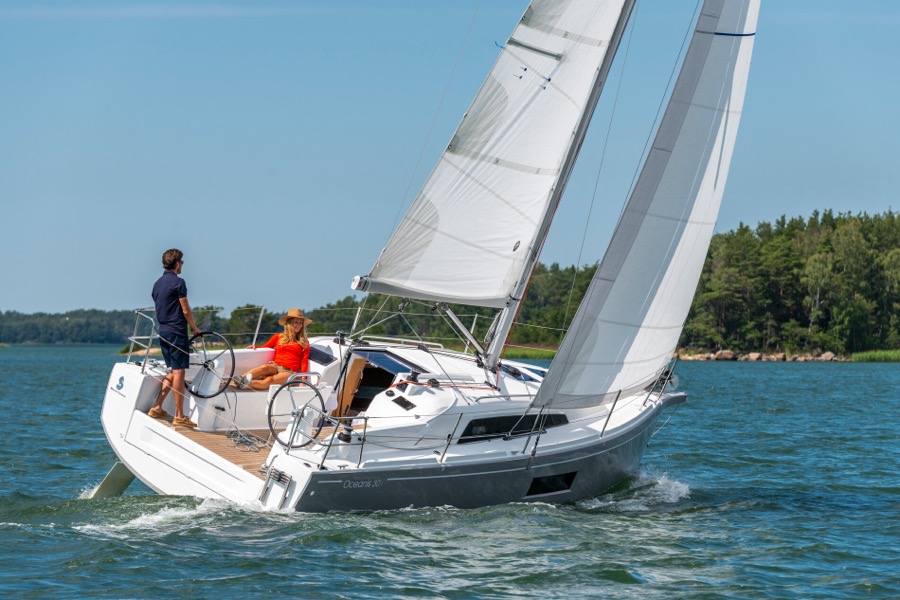
 When sailing near the coast, you always have to deal with wind, currents, tides (if sensitive) and sea conditions that are often directly related to the coastline profile and its topographical features.
In this article we will discuss what to expect when passing close to the coast (high or low), shortly in the next one we will address islands and river estuaries.
Low coasts
Low and sandy shorelines, steep cliffs, deep estuaries or islands and islets create different sailing conditions, wind and currents change significantly.
The wind undergoes major deviations whether it is synoptic, thus “gradient,” related to the weather situation of vast geographical areas and pressure differences, but also in the case of a simpler local thermal breeze, from the sea or land.
The actors acting between the solid forms of the earth are two: sea and wind, two fluids that both obey the physical law discovered by the Italian physicist Giovanni Battista Venturi, whereby “The pressure of a fluid current increases with decreasing velocity, and vice versa.”
In summary, for what concerns us most closely for this article: the velocity of a fluid’s flow increases when it is forced through a bottleneck.
Coastlines, when low and sloping, clearly have little effect on wind force and direction, since they are not a significant obstacle.
However, it is often observed that when the wind blows from the coast towards the open sea, it is deflected slightly to the right as soon as it reaches the sea, where the friction is less than on land and the Coriolis effect becomes more sensitive (Coriolis force is a force caused by the Earth’s rotation: a moving body will be moved to the right in the northern hemisphere and to the left in the southern hemisphere. The Coriolis force is zero at the equator and increases in magnitude toward the poles).
In some casesthe deviation is up to 25/30°. Personally, the places where I have noticed this effect the most have been sailing in France, in the parts of La Grande Motte and Sète (near Montpellier), and in Italy in the Upper and Middle Adriatic. 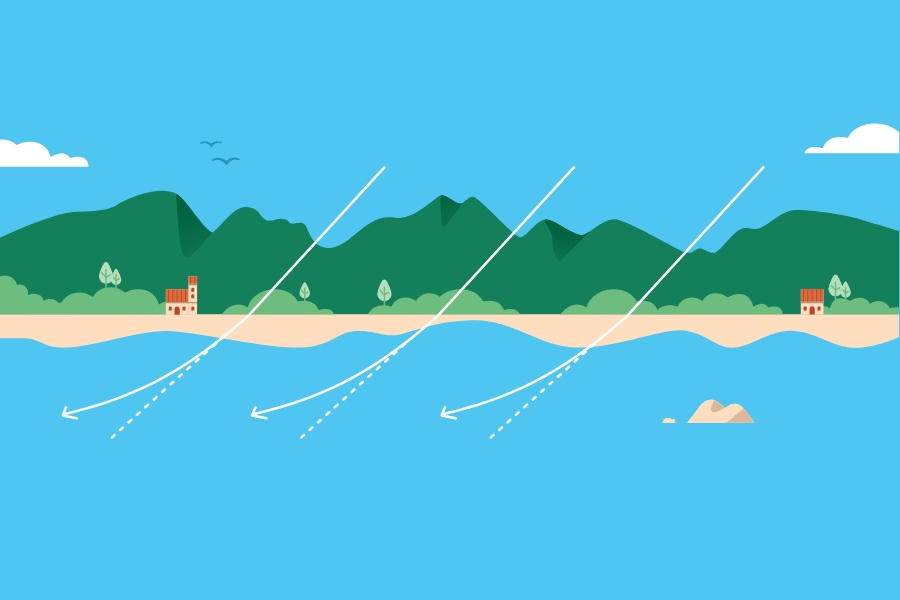
Along low-lying coasts if sea currents are present, they are weaker than where the water is deeper, for example when facing steep rocky cliffs.
One less danger to have to take into account especially when in waters facing low, slowly sloping rivieras, time filled with shallow water, whether sandy or rocky.
A separate case is in front of river estuaries, but we will discuss this in later article.
High ribs
The wind undergoes consistent changes near the coast when the coast is high, even if it consists of reliefs of varying size, not only if it is a classic sheer cliff.
If the wind trajectory is oblique to the orientation of the coast, there are two possible scenarios. When the wind blows slightly toward land, it is deflected to follow the coastline while increasing its strength. When the wind blows slightly toward the sea, it is also deflected to follow the coastline, but this time with a decrease in strength (and Mr. Venturi, or rather his law, is always responsible). 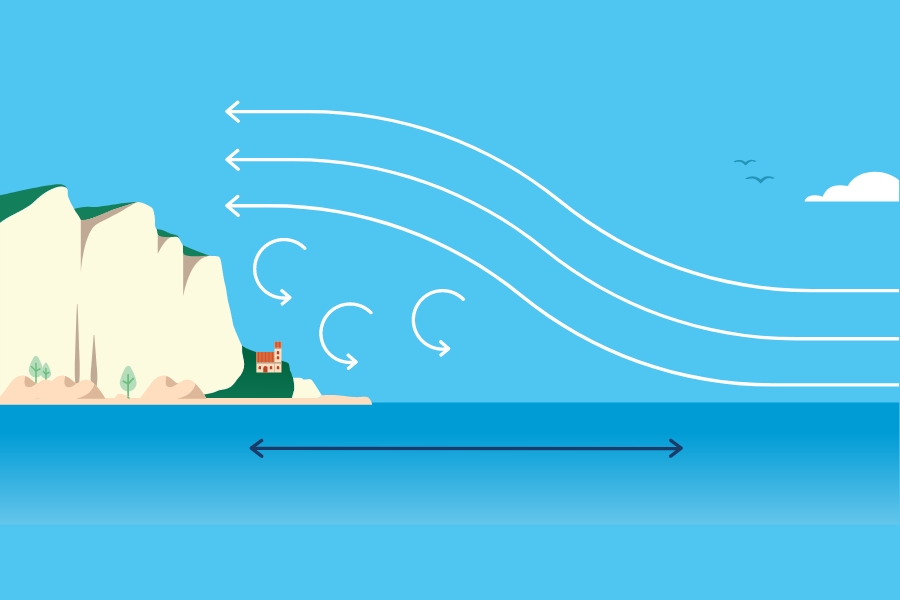
The wind decreases and becomes very unstable
The wind flow is “blocked” by the relief: part of the air mass rises to pass over it, while at sea level turbulence is created.
The wind becomes unstable, but also less strong.
This zone can extend seaward for a distance of 10-12 times the height of the relief. Here the situation when sailing can definitely become less enjoyable as not only do you have the coast downwind (always riskier than having it upwind) but also because control over the boat decreases due to the unstable and waning wind.
On the opposite, when the wind comes from the mainland, high elevations provide a protective barrier to the coastal strip; the wind will be significantly less strong but, again, much more unstable.
This wind shelter can extend seaward up to 25 or 30 times the height of the relief.
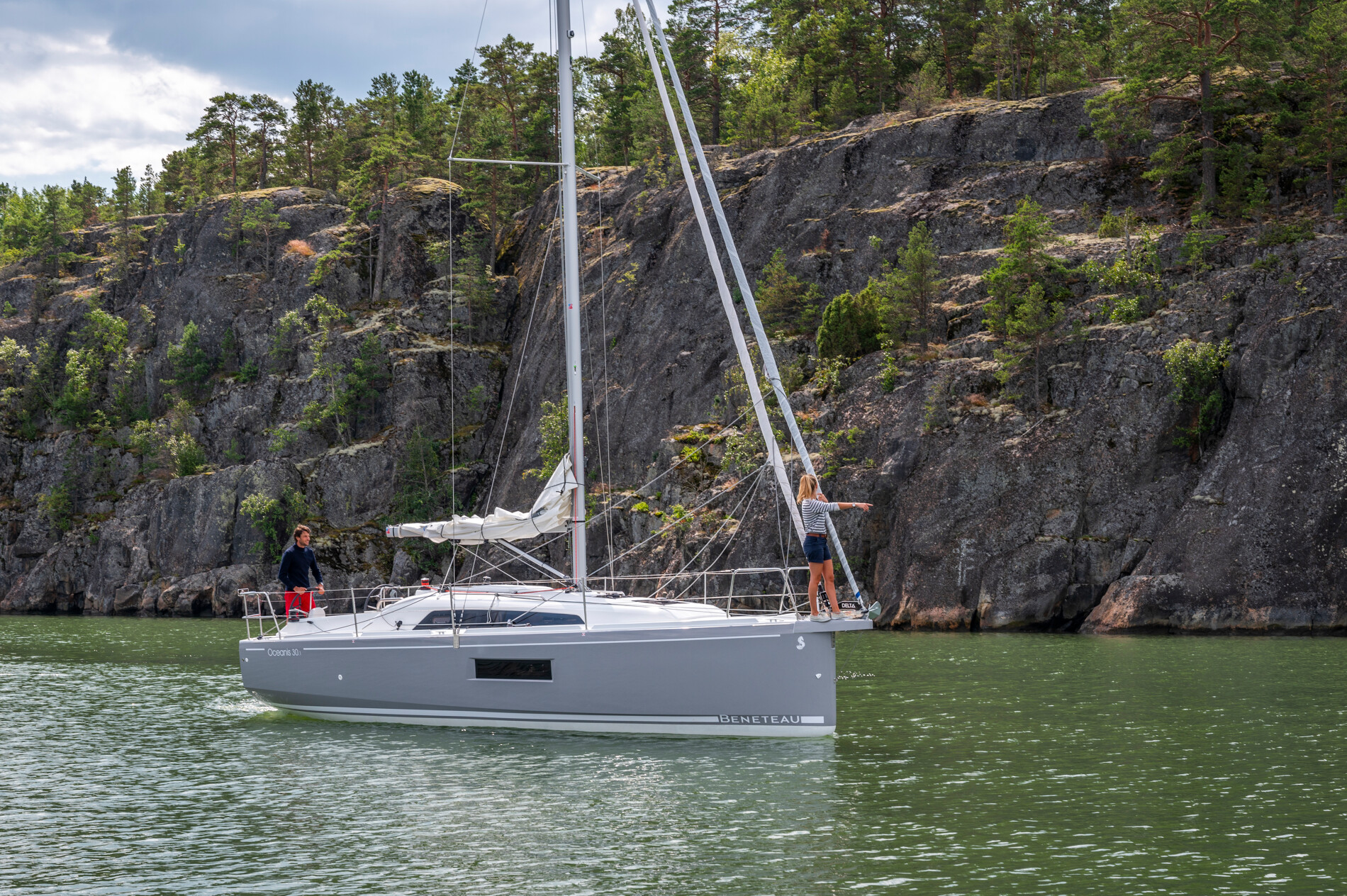
Sometimes, however, when the intensity of the wind blowing upwind of our shelter is particularly intense, sudden, almost vertical, downwind gusts can be discharged that are very treacherous.
Care must then be taken because sailing close to a mountainous coast whose slopes descend rapidly to the sea, when there is a strong wind upwind at the ridges, one can encounter strong “downwind” gusts that descend almost vertically (and anyone who has sailed in the Aegean with the Meltemi knows what we are talking about).
There is not only bad news, of course, for those who sail downwind of steep coastlines: on the one hand, the bathymetrics follow one another very closely on the chart (in other words, the bottom is immediately steep), so navigation is extremely safe; moreover, it is a place where fetch can never form (we discuss this in the next article afterwards), and so you will certainly have calm seas.
Check out the latest issue


Classic Boat Cult | 6 meters overall: agile, compact and exceptional
Small, compact, exceptional. Three words to best describe 7 boats that, combined in size, we believe are absolute must-have gems-both for culture and for potential purchase. In fact, in this our review of the great Classic Boats of the past,
USED BOATS Sell 5 hulls for all tastes from 5 to 17 meters
We continue to explore the best bargains on the used boat front in our classifieds marketplace. Here you can sell and buy used boats (even the Historic Classic Boat by Sailing Newspaper!), accessories, berths, finding the right idea for your
Classic Boat Cult | 10 meters overall: an outstanding segment (to be recovered) – pt.2
If, of all people, there is one segment that has declined in recent times, without a doubt, it is the 10-meter segment. Just think back to the ‘classic’ design, to the 1960s, 1970s, and even 1980s: 10-meter hulls were stately
Used under the lens: 4 historic Classic Boats for sale (9 to 12.5 meters)
The second-hand market, never more than for sailing, is a vast, complex world full of potholes and variables. And, if figuring out which boat is right for you, and which among the ones viewed is the best option, can be

