
Welcome to the special section “GdV 5th Years.” We are introducing you, day by day, An article from the archives of the Journal of Sailing, starting in 1975. A word of advice, get in the habit of starting your day with the most exciting sailing stories-it will be like being on a boat even if you are ashore.
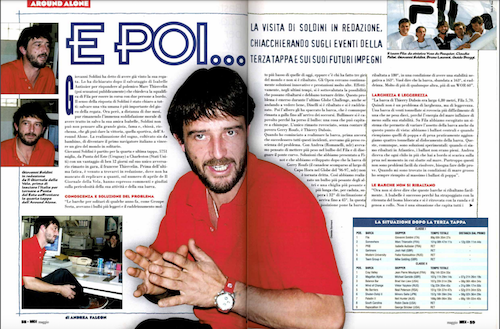
And then.
Taken from the 1999 Journal of Sailing, Year 25, No. 4, May, pp. 58/61.
Soldini wins the Around Alone solo round-the-world race amid controversy after rescuing Isabelle Autissier. Thus he became, in 1998, the most famous Italian sailor in the world. How the Milanese with salt water in his veins achieved a historic feat.
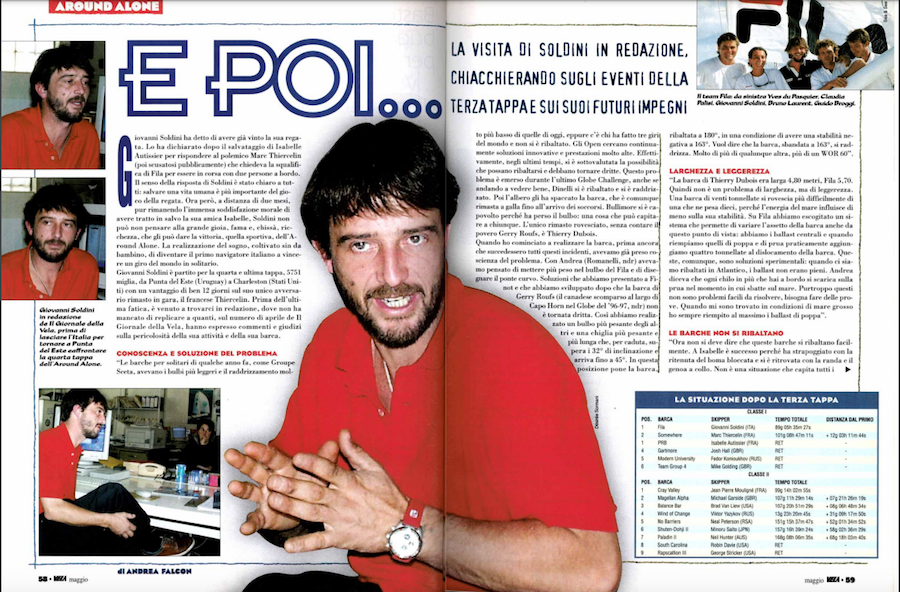
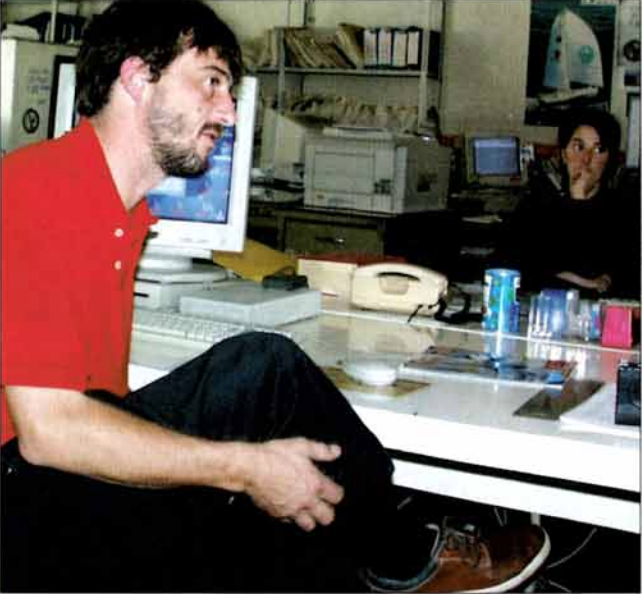
Giovanni Soldini said he had already won his regatta. He said this after the rescue of Isabelle Autissier to respond to the controversial Marc Thiercelin (who later apologized publicly) calling for the disqualification of Fila for being in the race with two people on board. The point of Soldini’s response was clear for all to see: saving a human life is more important than the game of racing. Now, however, two months later, while the immense moral satisfaction of having rescued his friend Isabelle remains, Soldini cannot help but think of the great joy, fame and, who knows, riches, that the victory, the sporting one, of Around Alone can give him. The realization of the dream, cultivated since childhood, of becoming the first Italian sailor to win a solo round-the-world race. Giovanni Soldini set off on the fourth and final leg, 5751 miles, from Punta Del Este (Uruguay) to Charleston (United States) with a lead of a full 12 days over his only remaining opponent in the race, Frenchman Thiercelin. Before his final effort, he visited us in the editorial office, where he did not fail to respond to those who, in the April issue of Il Giornale della Vela, made comments and judgments about the dangerousness of his activities and his boat.
Knowledge and solution of the problem
“Solitaire boats of a few years ago, such as Groupe Sceta, had lighter bulbs and much lower righting than those of today, yet there are those who have gone three times around the world and not capsized. The Open are constantly looking for innovative solutions and very high performance. Indeed, in recent times, there has been an underestimation of the possibility that they may tip over and have to go straight again. This problem also came up during the last Globe Challenge, although going by a good look, Dinelli tipped over and straightened up. Then the mast split his boat, which still stayed afloat until help arrived. Bullimore capsized because he lost his bulb: something that can happen to anyone. The only one left capsized, not counting poor Gerry Roufs, was Thierry Dubois. When I started making the boat, even before all these accidents happened, we had already become aware of the problem. With Andrea Romanelli we had thought about putting more weight in the bulb of Fila and designing the curved deck. Solutions we presented to Finot and developed after the boat of Gerry Roufs (the Canadian who disappeared off Cape Horn in the 96-97 Globe, ed.) did not come back straight. So we made a heavier bulb than the others and a heavier and longer keel that, by drop, exceeds 32° of pitch and goes up to 45°. In this position it puts the boat tipped 180°, in a condition of having negative stability at 163°. It means that the boat, heeled at 163°, straightens out. Much more than any other, more than a WOR60.”
Width and lightness
“Thierry Dubois’ boat was 4.80 meters wide, Fila 5.70. So it is not a problem of width, but of lightness. A boat of twenty tons capsizes more hardly than one that weighs ten, because the energy of the sea affects stability less. On Fila we have devised a system that allows us to vary the trim of the boat from this point of view as well: we have center ballasts and when we fill the stern and bow ones we practically add four tons to the displacement of the boat. These, however, are experimental solutions: when we capsized in the Atlantic, the ballasts were not full. Andrea said that every extra pound you have on board will s s load on the bow the moment it hits the sea. Unfortunately, these are not easy problems to solve; you have to test. When I have been in rough sea conditions, I have always filled the stern ballasts to the maximum.”
Boats do not capsize
“Now it should not be said that these boats capsize easily. It happened to Isabelle because she over-steered with the boom restraint stuck and ended up with her mainsail and genoa necked. This is not a situation that happens every day. I want to see how many of the boats that overhaul this way, with the boom not splitting, come back straight. My guess is not a single one. There the boom did not break and Isabelle did not have time to leave the restraint. She found herself overboard with her sails full of wind, in the back of a depression where the sea is mixed. That is definitely the most dangerous part, even if there is little wind.”
Isabelle Autissier’s Mistakes.
“Isabelle was not exactly an angel. She did the stability test of her boat and found that instead of righting at 117° as calculated, she did so at 112°. In spite of this, she raised the mast by one meter. In the long run these things pay off! He also had a shaft with a carbon modulus that allows for very small profiles. By going down in section you gain in aerodynamics: he always argued that the wing mast was unnecessary because, with high-modulus fibers, you can make diameters so small that they disturb the mainsail less. The wing one has to be spun, it’s a complex thing, but the advantage is not that great. Very fair argument, except, when a boat capsizes, the mast brakes you. There are two ways of capsizing: either with a lot of energy, so the mast breaks and it is easier to right itself, or with little energy, because of the wind. In that case, the tree does not break, but rests on the water and supports you. Such a small tree certainly did not hold it up. I never believed in the airbag. Finot realized that old boats like Isabelle’s (made in 1996, ed.) could have difficulty righting themselves. He said balloons that inflate with a cylinder should be provided so that the capsized boat would lack stability. Moulignè installed it on his Cray Valley; Isabelle, on PRB did not. It is also a matter of timing. The 60-foot class is complex; you can’t change boats overnight. Isabelle would have had to change the keel, bulb and redo the heaths. However, she would have been left with the serious problem of the flat deck. These are not two-minute jobs. Unfortunately, there are trade-offs with the economic interests of those who invest money on these boats, which still have to be accepted. It’s sad but that’s the way it is.”
Boats are safe, no more criticism
“No matter what, it is important that Isabelle is alive. So the degree of preparation and safety of these boats is actually very high. In my opinion in other classes and in other contexts safety is taken more lightly. Nobody equips the boats, or thinks about having hatches near the waterline to get out and in with some ease, or watertight bulkheads, or even checks the solidity of the hulls. I saw Sayonara, the maxi that won the Sidney to Hobart: after the race it was destroyed. It was in the yard three months. The same argument applies to the Whitbread boats: let’s not forget that several square meters of hull are cut off at the finish of the stages to replace delaminated parts. A boat that has done a Whitbread is finished! Nothing has happened to the WOR 60s so far; let’s hope they keep it up. Let them not say, though, that we are crazy and they have it all figured out instead. What really bothers me is that people make such heavy statements without realizing the complexity of the problem. Cori cannot say anything on this issue. If anyone is making non-marine boats it is him. If you give me one of Cori’s boats and I use it for a week, I’ll give it back to you that it’s not even afloat anymore. At thirty knots his boats drop out of races. How does he make a judgment on these things, having never tried to design a boat that faces the sea: he doesn’t set his sights on anything but the lake or the windless Adriatic Sea. Then there are those from Riviera di Rimini, a boat I like very much. I told them that they don’t comply with the international 60-foot regulations, because they don’t have enough keel, the bulb is not heavy enough, the safety coefficient is not very high, two or three watertight bulkheads and the insubmersible volume are missing. If they just do regattas in Italy that’s fine, but if they go to do the Tour of Europe there will be problems. Catherine Chabaud, who spent two billion on a 6-footer, will wonder why hers weighs ten tons and Riviera di Rimini six. Her boat has two tons more in the keel, has more structure, and she will not want this to go unnoticed. The Riviera di Rimini team says it will still be accepted because there are so few boats entered. I just hope they don’t encounter 50 knots upwind in the Bay of Biscay. The Whitbread people also need to stop claiming that they have it all figured out and that we are a bunch of reckless people. If we want to shoot at each other I have no problem with that. It might be helpful, however, to think about the experiences of others as well, try to imagine a WOR 60 capsizing or taking a depression in 90 knots. To date I am not aware of us ever taking more than 50. I have sailed for 24 hours with 85-knot gusts. I would like to see what would happen to a WOR 60 if it was in such a depression. If I were a WOR skipper I would think more carefully about it.”
Giovanni Soldini. What I would put on the cruising boats
“It would be a good thing if cruising boats had a hatch on the hull to get in and out and if they had a minimum of facilities to deal with tougher conditions than those encountered in Porto cervo on August 5. For example, Parsifal took a wave and broke into a thousand pieces, despite being a displacement boat and not extreme. Having a watertight bulkhead at the bow is not such an unthinkable thing. A watertight bow area, two, three meters, on a twenty-meter boat would be a good idea, as would a watertight bulkhead separating the luff from the rudder of the livable area. At Around Alone we use two self-inflating boats, one is placed inside the boat: the one on the deck, when you get a lot of wind, it always gets blown away. I always kept it inside. With Andrea, we decided to resign one on the transom so that we could take it both from outside and inside. It ended up being a solution adopted by all participants. It is clear that you cannot have everything: if you want trailer boats, you can do them, but they are not safe. Many boat owners, in fact, decide to go to the Caribbean by loading the boat on a ship. Or 30-meter boats from New Zealand: they dream of sailing to Italy.”
Text by Andrea Falcon.
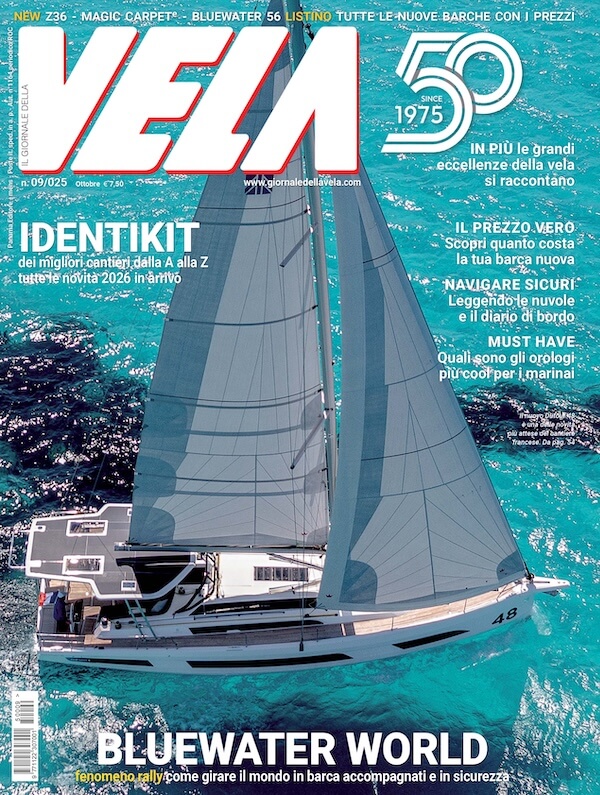
Check out the latest issue

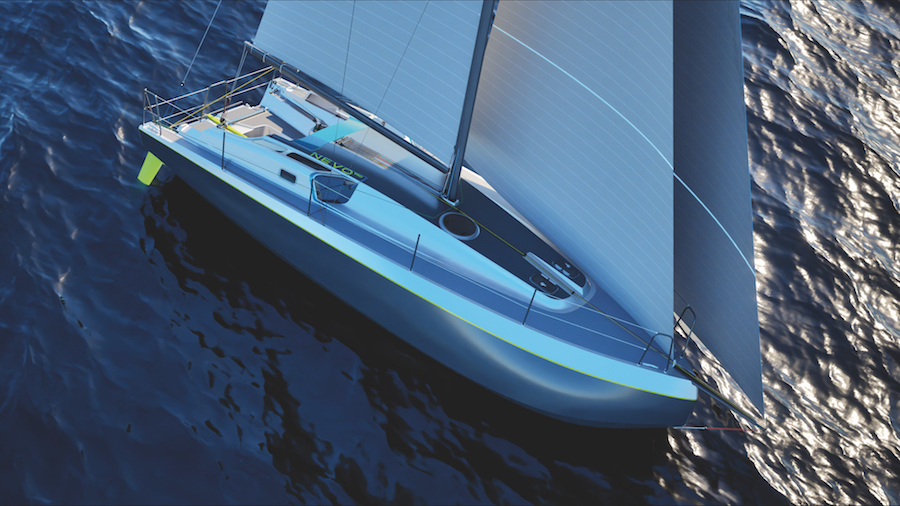
Michele Molino, nautical engineer with the sea in his vein
On the occasion of the 50th anniversary of the Journal of Sailing, the great excellences of the sailing world tell their stories and reveal their projects. In this column, discover all the companies and people who have made important contributions
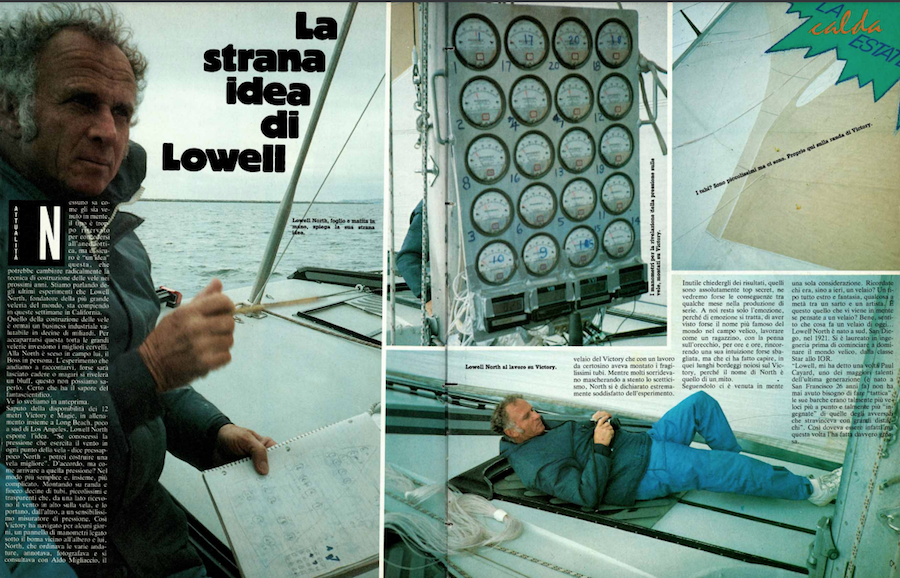
1985. The sails of the future are being born. The GdV is in, with Lowell North
Welcome to the special section “GdV 5th Years.” We are introducing you, day by day, An article from the archives of the Journal of Sailing, starting in 1975. A word of advice, get in the habit of starting your day
Marinedi, the integrated hospitality system
On the occasion of the 50th anniversary of the Journal of Sailing, the great excellences of the sailing world tell their stories and reveal their projects. In this column, discover all the companies and people who have made important contributions
Naval revolution goes through Judel/Vrolijk study
On the occasion of the 50th anniversary of the Journal of Sailing, the great excellences of the sailing world tell their stories and reveal their projects. In this column, discover all the companies and people who have made important contributions

