Welcome to the special section “GdV 5th Years.” We are introducing you, day by day, An article from the archives of the Journal of Sailing, starting in 1975. A word of advice, get in the habit of starting your day with the most exciting sailing stories-it will be like being on a boat even if you are ashore.
How to reinvent sailing.
Excerpted from the 2024 Journal of Sailing. Year 50, No. 4, May, pp. 70-77.
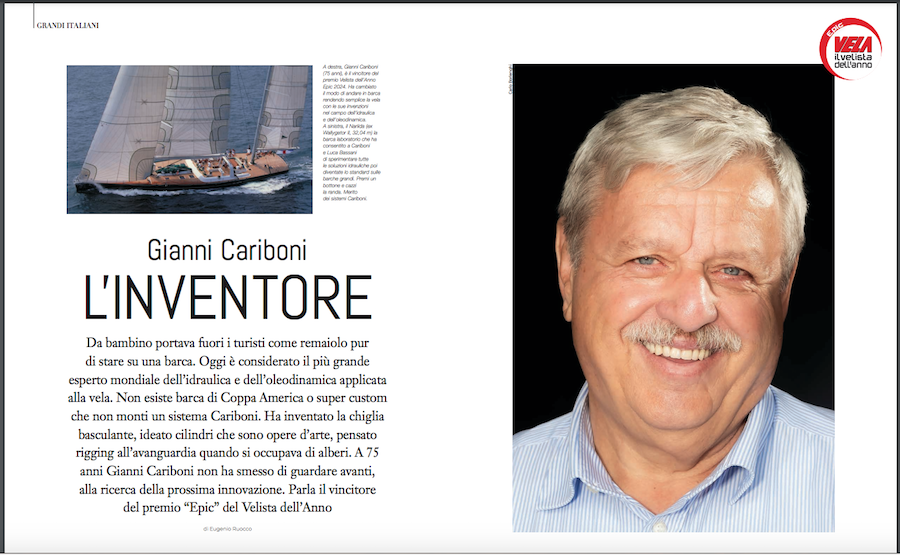
As a child, he used to take tourists around the lake as long as he was in a boat. Today he is the great expert on hydraulics and hydraulics applied to sailing. There is no America’s Cup or custom boat that does not mount a Cariboni system. He invented everything from the canting keel. With only one purpose, to sail better.
Gianni Cariboni, the inventor
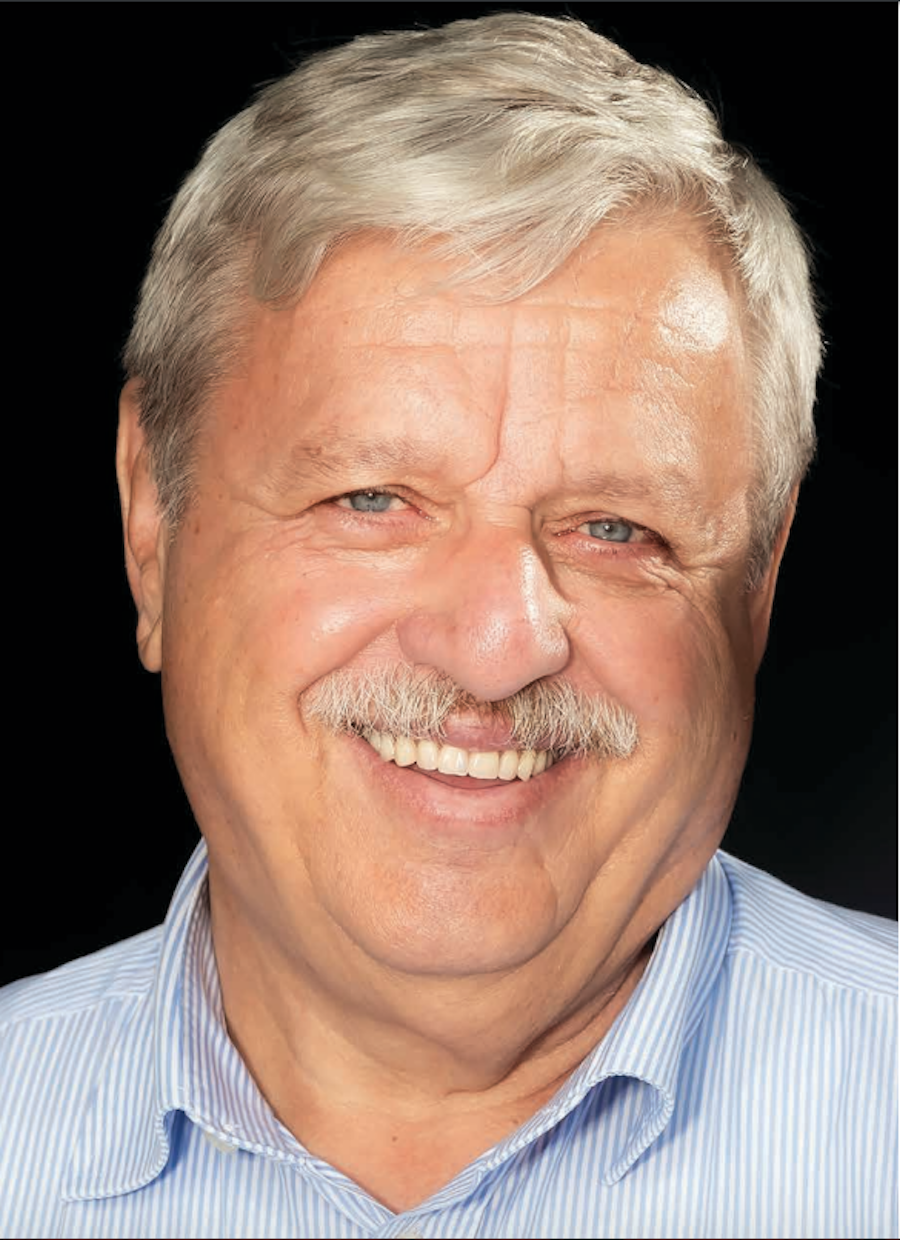
As a child he took tourists out as a paddler as long as he was on a boat. Today he is considered the world’s foremost expert on hydraulics and hydraulics applied to sailing. There is no America’s Cup or super custom boat that does not mount a Cariboni system. He invented the canting keel, devised cylinders that are works of art, thought up cutting-edge rigging when he was dealing with masts. At 75, Gianni Cariboni has not stopped looking ahead, searching for the next innovation. The winner of the Sailor of the Year “Epic” award speaks.
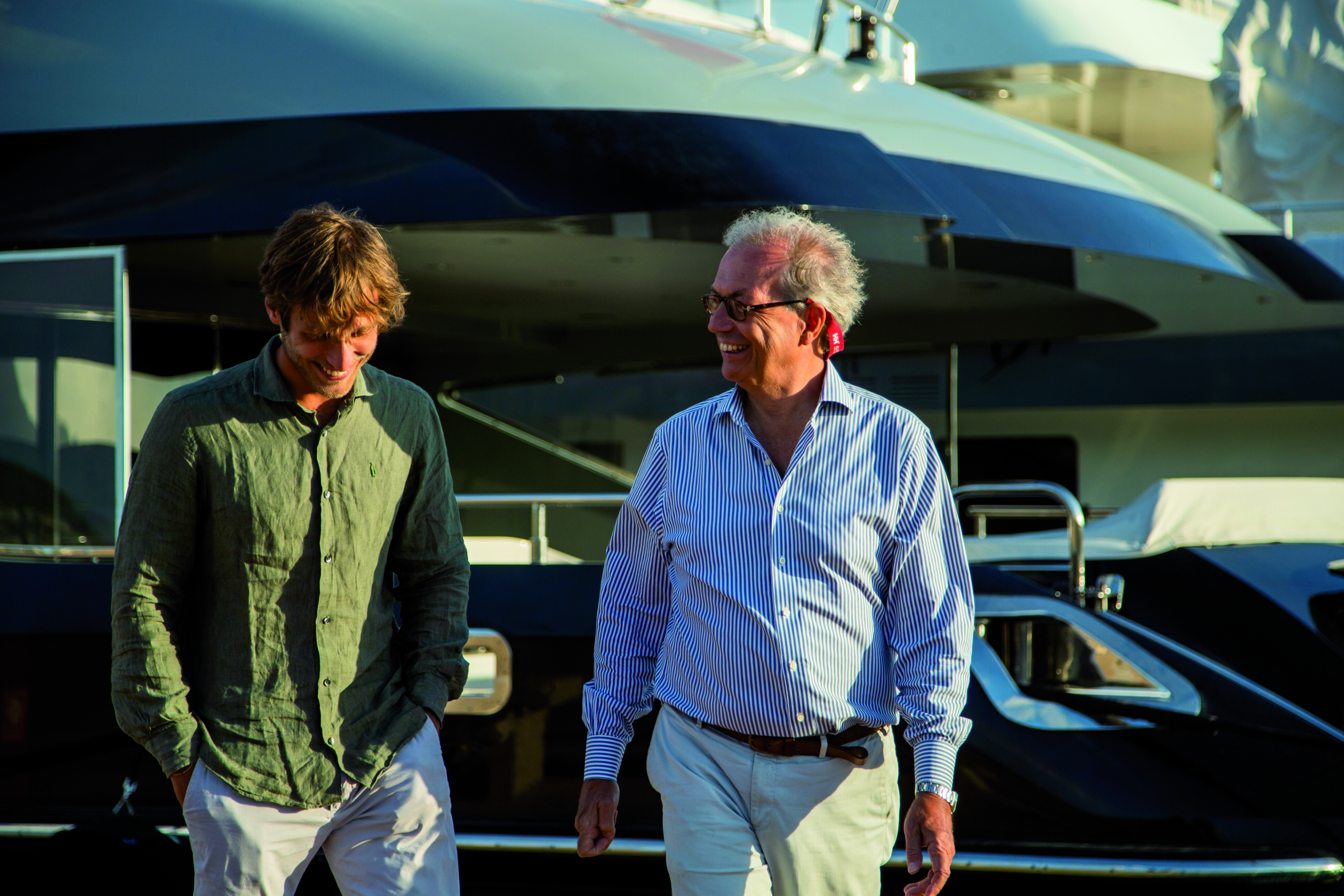
I am in a small office, in Ronco Briantino, in the Brianza province. In front of me I have the Epic 2024 Sailor of the Year. No one voted for him because it is a lifetime achievement award, given at the sole discretion of the GdV jury. The gentleman, with a mustache, is 75 years old and speaks with a thick Lombard accent. His last name is Cariboni and his first name is Gianni; he heads the company that bears his name, Cariboni, precisely. Some 30 employees, 9 million in sales, an international excellence in hydraulics and hydraulics applied to sailboats. In the America’s Cup, no one can do without him, for all on-board handling: not only Luna Rossa, but all the teams. He has designed hydraulic systems for the world’s most beautiful sailboats, he is the inventor of the canting keel, he invented a cylinder with which you press a button and adjust the mainsail: there is no custom that does not mount a Cariboni idea. He made sailing simple with his ideas. If a boat needs a cylinder, or a piston, a keel that moves, Gianni Cariboni takes care of it. An Italian genius born to two workers who as a child rowed on Lake Como just to be on the water. In 2024, Cariboni (a company that remains family-owned, with children Paola and Marco working alongside Gianni) turned 40 years old. But the story begins long before that.
GdV – Gianni, let’s start far back. Where and when were you born?
Gianni Cariboni – I am a full-blooded laghé. I was born in Bellano on November 16, 1948. And for the last 24 years, I have celebrated my birthday at METS (the boat accessories show in Amsterdam, which is always held in mid-November, ed.). I can’t get enough of Dutch cakes!
GdV – Your first memory related to water?
GC – I was born exactly opposite the port of Bellano. I would basically cross Provincial Road 72 and end up in the lake! I’ve always had a strong attraction to water. I can’t say why.
GdV – Were there any sailors in your family?
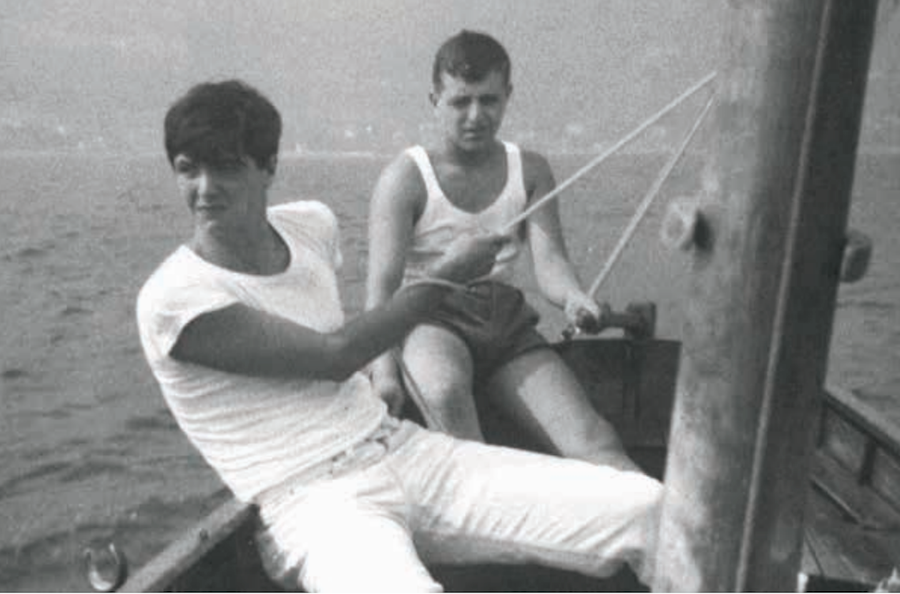
Gianni Cariboni – Absolutely not, let alone. I come from an underprivileged family, my parents were two laborers who made a thousand sacrifices so that I could study. But as I was telling you, from an early age I couldn’t stay away from the water. I immediately started to be a boatman, cleaning the boats, and by the time I was 8-9 years old I was rowing on the small lances that welcomed tourists. Some of them were equipped with a Dinghy-type dinghy drift and mast coaming: when there was a chance, I would get two tips, rig the mast, rig the sail, and go out and make two edges. No sailing courses-they didn’t even exist back then. I had two third cousins: one ran the dock in Bellano where the spears were moored, the other had a small boatyard that made just these little boats and also went sailing (as a crew, of course). From them I also learned the first secrets of construction. Then, there were those who had the real sailboats in the marina. I would help clean them and do chores on board, and the owners would take me out with them. When I was a little older, about 13-14 years old, with my family we went to live in an annex of the villa where the brothers Emilio and Dado Castelli, good sailors, lived. We often went out on the boat together. So, slowly, I got into the sailing business… Then, I had a distant kinship with Raffaele Manara, who raced on the 5.50 International Tonnage (Volpina I, II, III, IV, V) together with engineer Giulio Cesare Carcano. Raffaele was my first real sailing teacher. I did a lot of regattas on 5.50s with them, and not only on the lake. Raffaele had a small boatyard just outside Bellano, from him I learned to really know the boats. Understand if the boat is going right, if it is going wrong, if it has some difference in trim….
GdV – Even then you liked to reason about things…
GC – In all the activities I have been involved in (besides sailing, skiing, scuba diving and then golf, ed.) I have always been interested in the technical part and I have always had a thousand “mental wanks” (laughs). Engineer in soul. I am actually a simple mechanical engineer. All the culture related to the design part was passed on to me by Engineer Carcano. This man was THE designer. From him I learned the design philosophy, not the notional part. He taught me to think about how to use a design. And that’s not for everyone, really. Carcano’s lesson? “If you have a design idea that you’re sure of,” he once told me, “pursue it. But never in an imposing way. Always be proactive, learn to listen to everyone. Maybe you talk to a hundred thousand people about it, 999,999 people will tell you stupid things but one will give you an idea you would never have thought of.” This is the philosophy I have always applied and will always apply in my work at Cariboni.
GdV – Give us an example.
GC – America’s Cup, second campaign of Luna Rossa (2001-2003, ed.). In the various pre-Cup tests and experiments, Prada not only put a rudder on the bow that had to work coordinated with the stern rudder, but also installed a very large trim-tab. When you moved the blade from the top, it would “twitch” and lose effectiveness because the laminar flow acts down, so we had decided to install the trim-tab control at the bottom: a hydraulic contraption mounted near the bulb. But we couldn’t hold it down! Francesco De Angelis was giving me feedback, “Gianni, we lose a tenth of a degree to windward–Gianni, we lose two!” We couldn’t solve the problem, we couldn’t get to the bottom of it. After the tests, we go back ashore, discouraged. I mention this to a gentleman who says , “but why don’t you put a screw in it?” A screw, the light bulb goes on in my head. A non-reversible worm screw. The trim-tab system has been solved mechanically with a servo cylinder driven by a worm screw. Thanks to that gentleman’s cue!
GdV – Do you remember your first real regatta?
GC – Right. I had raced on the bow of the Snipe (the Snipe dinghies, ed.) on the Lake, but my first serious regatta as a bowman was in Lierna, aboard a Star, Nuvola Azzurra which the legendary skipper Dario Salata had sold to the founder of the Larian boat museum, Count Gian Alberto Zanoletti. She was azure in name and in fact. Light blue hull, light blue sails, light blue mast.
GdV – When did you decide that you were going to be a… technician?
GC – I was in the military at Vigna di Valle (I was the first airman in the nautical section of the Navy!), they asked me to run the sports center that is still there on Lake Bracciano. But I refused, because I had had an offer to become a teacher in the school where I had studied, close to home, at the Badoni Institute in Lecco: my mom Carolina and dad Marco, blue-collar workers, were looking forward to having a son who would work, with a secure position, for the Italian state.
GdV – At 20 years old already a teacher … what did you teach?
GC – Technology. It was a wonderful experience, two perfect years.
GdV – Then what?
GC – Then through various acquaintances I was offered a job in a sheet metal stamping company, Ettore Frigerio in Lecco: the salary was far more than the 90,000 liras a month (93,000 with overtime!). Reluctantly I left teaching and entered as test manager, then moved on to production management. Always remembering Carcano’s teaching. Think, decide, learn to listen. How did you balance work with sailing? Time was short, I had stopped racing on the then Olympic classes (5.50, Star, FD), to devote myself to the “gabinati,” with a G, as they were called by us, always on the lake. The first boat I went on was a Grazia, purchased from Dino Canclini. It was a small sloop that was a great commercial success, sponsored by Grazia magazine, complete with curtains in the portholes, but it didn’t walk much. Then Canclini fortunately got a Brigand 7.50…
GdV – You mentioned Canclini’s name. Important for your career…
GC – Dino Canclini, who was taking over a small workshop near Bellano: he said, “come on, come to me and design masts. “ My mother went out of her mind: she had not taken well to my leaving teaching to go to the firm, let alone when I told her I was going to build masts for boats!
GdV – The turning point. Gianni Cariboni enters sailing.
GC – A good time, which coincided with my marriage – 50 years ago, it was 1974 – to Maria Maggioni called Mary, my wife. The adventure started, the relationship with Dino was great, and I finally combined my passion for sailing with my “culture.” The experience with Canclini was fundamental. I met a lot of designers and delved into the world of builders. We grew so much as a company and when I left we were producing 4,500 masts a year between France, Italy, Switzerland and we had three factories: in Lomagna, in Velate and Verderio, in Brianza
GdV – Let’s come to a date. June 20, 1984.
GC – The day your life changed. Even more precisely, at 12:03 p.m. The exact moment I gave my irrevocable resignation from Canclini. I was pissed as hell (he won’t say why, ed.) and closed with the company. I left without having a plan B. With wife at home, two children (Paola and Marco), renting! I got on a motorcycle (obviously a Moto Guzzi 850 t3, Carcano engine) to clear my head. I headed to Zibido San Giacomo to Hood ‘s young sailmakers (represented then by Negrinautica) Marco Pomi and Fabio Vitali (whom I had taught how to boat) to chat, met the owner Giovanna Negri, who as soon as she heard that I had quit my job at Canclini took me to the office. Waiting for us was Paolo Martinoni, who at the time was in charge of managing Hood in Italy: “Gianni, we have a gyroflo to assemble in Rapallo, will you take care of it?” “Okay, fine.” I had never assembled a girafiocco in my life. I went back home. I dumped the bike. I took the car, routed to Zibido, got the rollafiocco box, came home, tried to assemble it in the hallway of the house. Okay, I knew how to do it. I left for Rapallo, where I plowed the gyrofoil on the Swan of owner Tonino Domenicali, who was pleased with the speed of the work and the cost of assembly. He said, “While we’re at it, I’d like to change the anchor windlass as well.” On the way home I stopped at Lofrans, got the windlass with a post-dated check (I didn’t have the money to advance), in two days I had fitted it for him. Thus, I began to get my hands, really, into the boats.
GdV – Meanwhile, there is a rumor of your exit from Canclini…
GC – Enrico Contreas, the designer of the Mattia catamarans, showed up: “Gianni, I would need you to draw some hardware parts for my boats.” I bought two drawing tables from the bankruptcy of Forni Impianti in Lecco, brought them to a basement under our house. There, that was Cariboni Giovanni‘s first office. I designed aluminum dinghies for the Mattia, designed masts for Plastivela. In Verderio I then rented a ten-by-eight-foot space in a dusty heavy carpentry shed, bought a used hacksaw and started assembling shaft profiles.
GdV – One of your first major works?
GC – The boom of Azzurra, in 1987. We made it from folded sheet metal, applying the philosophy of composite…
GdV – That’s how you landed in the America’s Cup!
GC – Easy, easy, that was a first, sporadic foray. Let’s go back to the boom (he starts sketching on his inseparable clipboard, ed.): I started from the principle of leaf spring train suspensions, where more material is used at the points of greatest load. The boom of Azzurra, made of 3 mm sheet metal, had aluminum reinforcement plates at the load points (like vang attachment, sheet). It was also rotating with pistons, but I was not yet chewing hydraulics and hydraulics. I would deal with that one a little later, for the first time with the Magdalus III (1988), the 35-meter boat built by Ortona/Perini for Danilo Fossati, the owner of Star (the food giant, ed.): back then we made a motorized hydraulic power unit to control the mast, with stainless steel tanks and manifolds (unlike back then, which were made of aluminum or painted iron, with the part made of regular steel and carbon).
GdV – Let’s go back. Tell us about your early encounters with Luca Bassani, a key person for you.
GC – When I worked at Canclini, the Bassani family (the industrialists of the multinational electrical equipment company BTicino) had rented the C&C 66 Phantom, with which he had disalberated in Porto Cervo and turned to us. I went down to Rapallo with Luca Bassani to see the broken mast. “Gianni, can it be repaired?” “Yes, it can, it can.” Too bad we did not have the right welder in the company. We had the new profile flown in from Canada, bought the new welder and carried out the work. Bassani was pleased, invited me to see it assembled in Porto Cervo that summer. Years went by: the Bassani family focused on the smaller 6-meter International Meter and in the late 1980s Luca came back to me: he wanted to rent our shed to build the 6-meter masts. I refused, we had a series of orders that we could not disregard, he left quite testy: however, I think he appreciated our honesty in not promising what we could not do. In the meantime, I had begun to collaborate with Luca Brenta, whom I had met while racing on the VI Class IORs. He on his beautiful Dinamite, me on the Viracocha by Canclini, designed by Claudio Maletto. When Brenta designed for Bassani the Wally 83 (the WallyOne built by Sangermani in 1991, ed.) I was in charge of the mast. Here I am with Bassani again!
GdV – In 1993 the Wallygator II, the boat that best represents Bassani’s vision and, let’s face it, yours, came to life. Making it easy to go sailing.
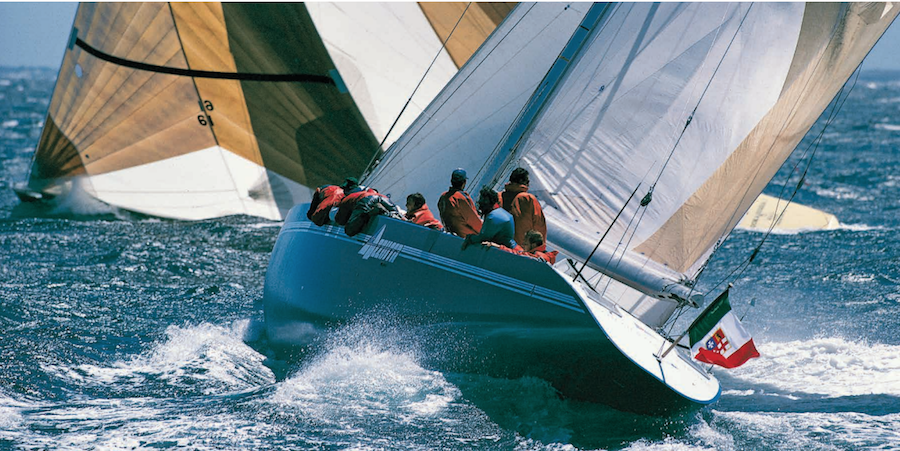
GC – That was a truly revolutionary “bassanata,” the 105-footer, the Wallygator II (today Nariida, ed.), designed by Brenta. Everything aboard was assisted by hydraulic motions (mainsail sheet, keel, daggerboard) and the twin engines (one amidships and one forward) mounted rotating propellers with four retractable blades. The two engines were not only used as a propulsion system, but also as an alternative power source… Luke had the ideas (and what ideas!), I was the one who put them into practice. And that is still the case today!
GdV – One of your inventions, for sure, is the canting keel on big boats. How did you come up with the idea?
GC – I was aboard a Grand Soleil 46 in the Adriatic. I was at the helm, in heavy seas, and asked the owner to go below deck to get some water. She came back up pale and seasick. That’s when I thought, Why don’t we make the boat go straight? Just shift the weight, right? On dinghies, the trapeze serves no purpose other than to keep the boat straight, after all. It would have been enough to find a mechanical system that did the job….
GdV – Between the idea and its implementation, however, lies the sea. And, more importantly, the means to implement it.
GC – The opportunity came in the person of concrete king Sandro Buzzi, who for his boat, the Open 60 Junoplano (Vismara project, 1996, ed.) wanted at all costs a canting keel, a solution he had heard had been applied on a small Soling. We devised a 55-degree, single-cylinder canting keel, using an aeronautical approach to maintain the bearings that rotated the keel, based on friction. It was the boat that paved the way for canting keels.
GdV – In 1997, in fact…
Gianni Cariboni –…there was a knock at the door for Giovanni Soldini. Since for his Amazing Kodak, some time earlier he had asked me if I had given him the tree (but it was not the time then, I did not have the resources), the first thing he said to me was, “I have the money!” For his Open 60 Row we designed the canting keel, the hydraulic handling system and all the special components….
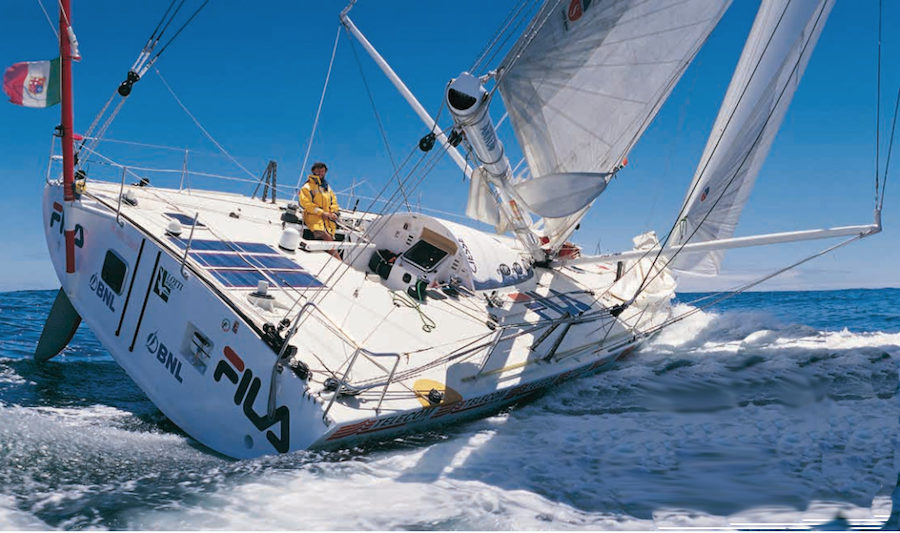
GdV – We come to Cariboni’s “real” entry into the America’s Cup.
GC – In 1998 we made the canting keel for the Wally 88 Tiketitan, in a meeting with German Frers, the designer asked me, “But would you be able to make cylinders, small ones, to put in the jumpers (the high spreader of the mast, ed.) of Luna Rossa? If yes, make them!” But by regulation, they had to move together, regardless of the load: the upwind one had all the load, the downwind one didn’t… We patented a particular cylinder with a double chamber to adjust the angle of the struts. This solution was later applied to all the Cup boats and marked Cariboni’s entry into America’s Cup hydraulics and hydraulics. An Italian company in a world dominated by Anglo-Saxons. It was not easy in the beginning: but even today we still do all the foil booms, hydraulics and hydraulics in the America’s Cup.
GdV – What are the things you “invented”?
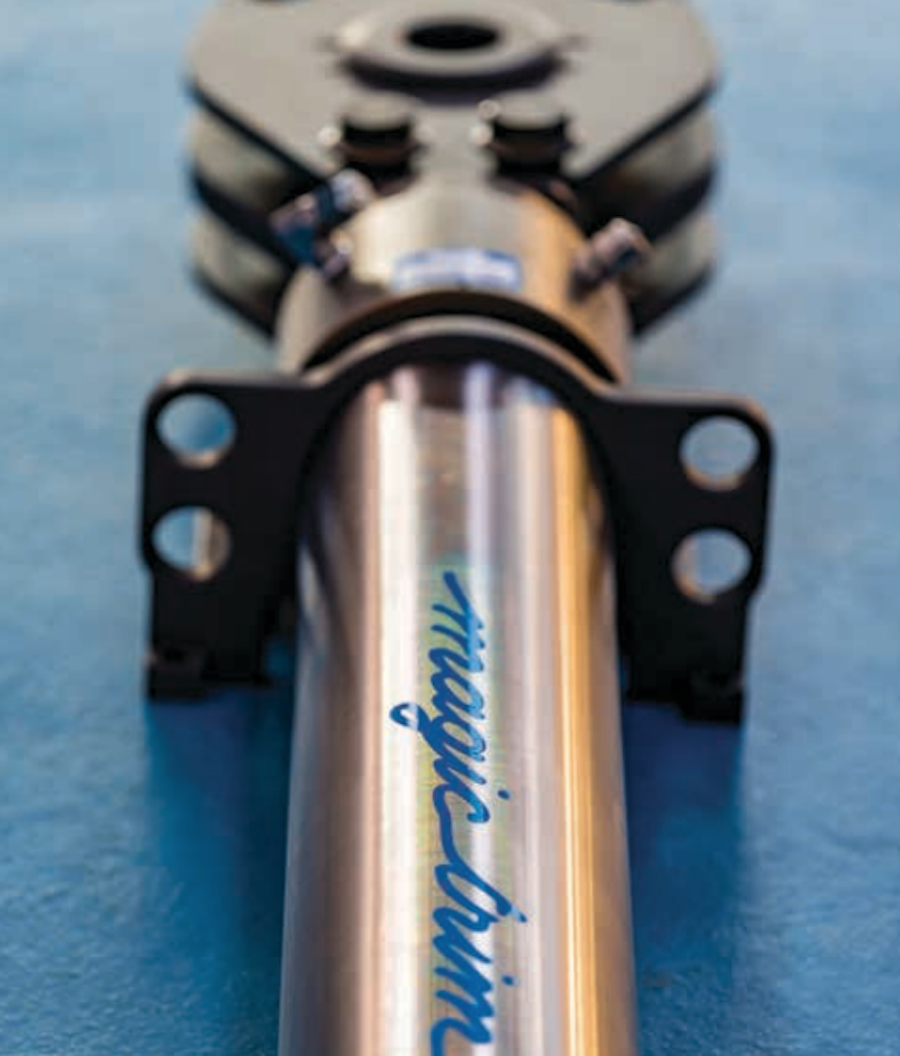
GC – Of the development of the canting keel we have talked. Also of the double-speed cylinder for adjusting the mainsail, the Magic Trim, I am particularly proud. And, of course, of Bassani’s whole philosophy of easy sailing, which I have made my own: sailing should be easy, not slavery. Luca and I believed in each other’s ideas. I owe him so much. I can then think of other “firsts” in the sailing world: we made the first carbon mast in Europe with Chris Mitchell lamination and Galetti profile construction, for the boat Mr Gecko, the first piston for tensioning the forestay and the first mast jack integrated into the mast (Wally 83). I forgot: the first canting and lifting keel for the 115-ft. Maiden Hong Kong, in 2003.
GdV – The designer you worked on best, excluding Bassani?
GC – I work well with everybody. However Bassani (laughs).
GdV – What is your typical boat?
GC – It’s called Superstar (today Crisco Star), 9.60 m boat. A Star in large, canting and lifting keel, totally automated by us, designed by Luca Brenta. Just rudder and push buttons. An old idea of mine and Luca’s ,“to challenge us on the water we make two of them, with white sails.” At first it stayed in the drawer because of the crazy cost of making it. One day Brenta,it was 2012, called me, “We found the money, there is a customer who is paying for it! Then we use the molds on it!” A little object worth more than two million euros. On the one hand it was the perfect boat, but it was also cursed: Alfio Peraboni was to follow the rigging and before the project was finished he passed away. Brenta was stricken with a stroke, I had to have three bypasses.
GdV – What will the boats of the future look like?
GC – Hydrogen. Certainly when they can produce hydrogen more economically, the future in propulsion is there. Pure hydrogen. Nothing to do with electric which is an inefficient system.
GdV – What about the foils?
GC – Definitely they are an energy saver. For the same wind energy, a racing boat without a foil 20 years ago would make 20 knots. Today it does 50. I don’t see the future of flying boats for everyone, but certainly foils will be used to reduce the wetted area not only in the racing world.
GdV – Who is your legendary sailor?
GC – Raffaele Manara. We have already talked about that. He taught me, he had a unique sensitivity… The best Cup coxswain, however, for me is Jimmy Spithill.
GdV – Do you also go on a cruise? Do you like it?
GC – I like it very much, I go there with clients if I have time. But despite my age, of free time, I still have very little!
GdV – The most beautiful boat in sailing history and why.
GC – The 5.50 M S.I. Volpina Carcano’s. I saw her being born. A boat that touched me inside: I’m not talking about her aesthetic side. When you board a boat, you give something to her, and she gives something to you. A principle of interchange: I felt one with the Volpina.
GdV – The ugliest one.
GC – “A” by Andrei Melnichenko. But it’s not even a sailboat! (Laughs)
GdV – The historical figure that inspired you the most?
GC – Leonardo Da Vinci, and who else? I am amazed when I take the Imbersago ferry at zero energy, 200 watts and you make the crossing of the Adda. Crazy, and above all he was a great multifaceted experimenter who was not afraid to be wrong. Leonardo was hundreds of years ahead…
GdV – What would you like people to remember about Gianni Cariboni?
GC – I am a great believer in loyalty and honesty. I hope they remember me as loyal and honest, rather than as a plumbing “guru” (laughs, ed.).
Eugene Ruocco
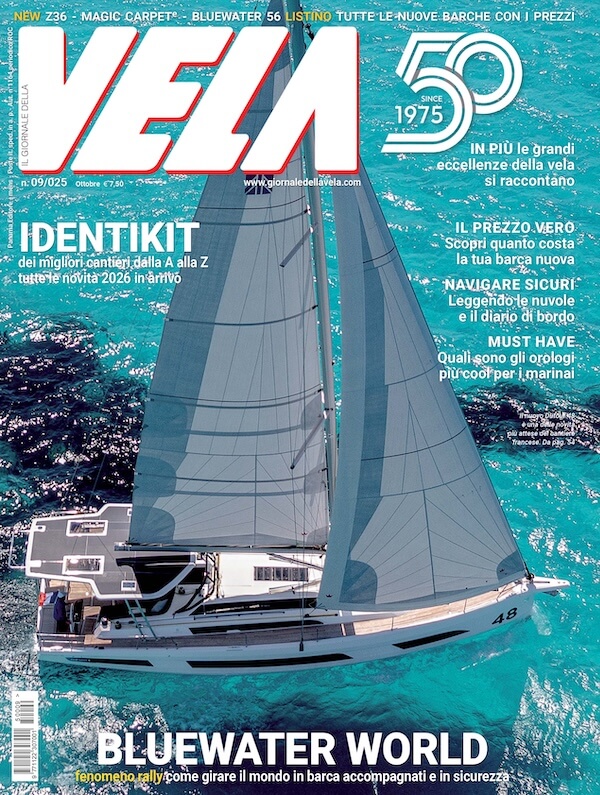
Check out the latest issue

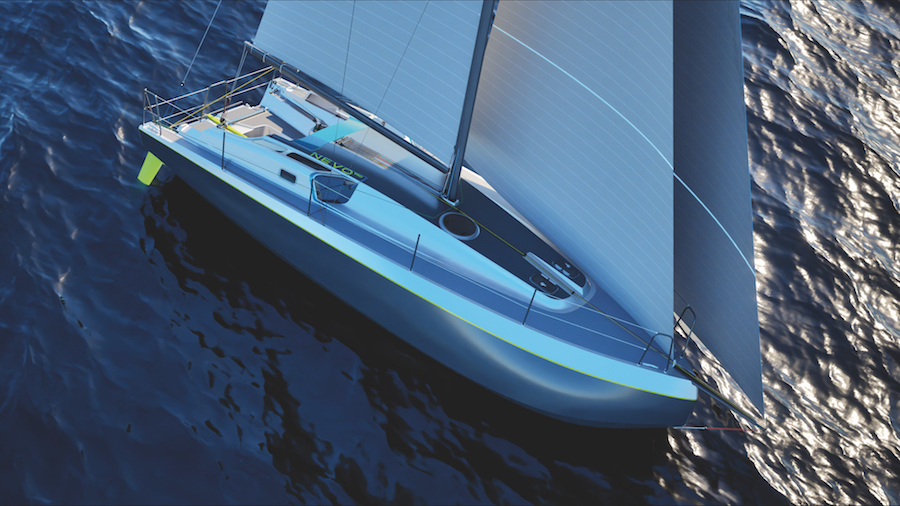
Michele Molino, nautical engineer with the sea in his vein
On the occasion of the 50th anniversary of the Journal of Sailing, the great excellences of the sailing world tell their stories and reveal their projects. In this column, discover all the companies and people who have made important contributions
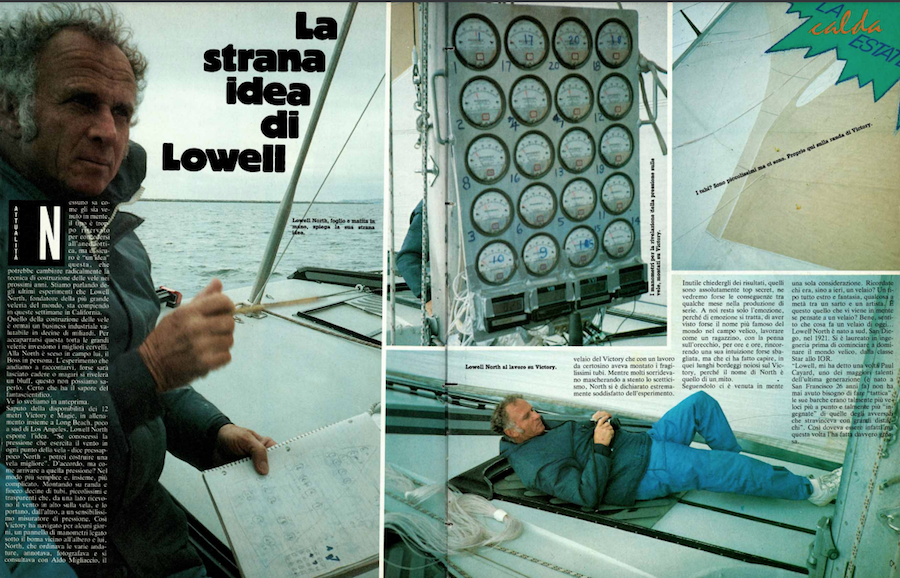
1985. The sails of the future are being born. The GdV is in, with Lowell North
Welcome to the special section “GdV 5th Years.” We are introducing you, day by day, An article from the archives of the Journal of Sailing, starting in 1975. A word of advice, get in the habit of starting your day
Marinedi, the integrated hospitality system
On the occasion of the 50th anniversary of the Journal of Sailing, the great excellences of the sailing world tell their stories and reveal their projects. In this column, discover all the companies and people who have made important contributions
Naval revolution goes through Judel/Vrolijk study
On the occasion of the 50th anniversary of the Journal of Sailing, the great excellences of the sailing world tell their stories and reveal their projects. In this column, discover all the companies and people who have made important contributions

