Welcome to the special section “GdV 5th Years.” We are introducing you, day by day, An article from the archives of the Journal of Sailing, starting in 1975. A word of advice, get in the habit of starting your day with the most exciting sailing stories-it will be like being on a boat even if you are ashore.
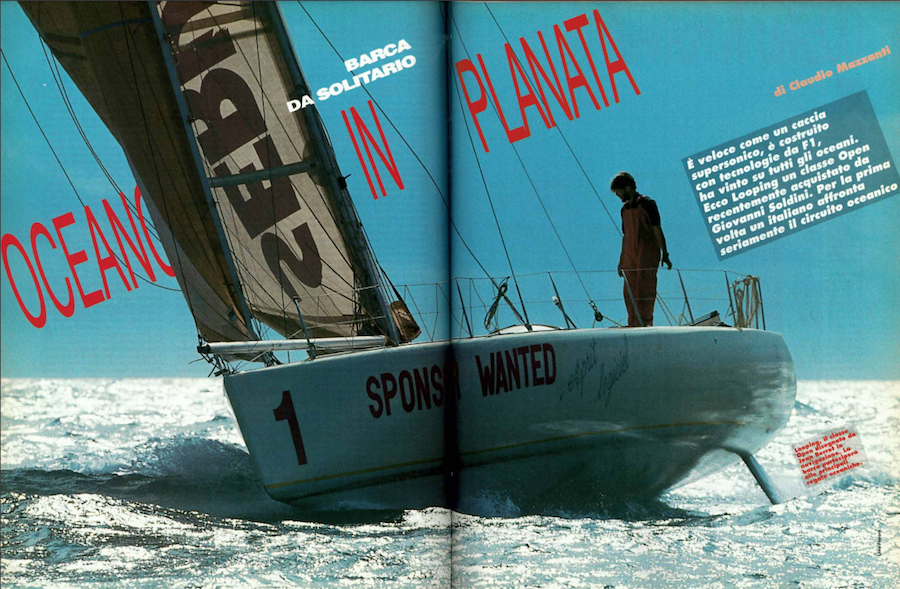
Gliding ocean
Taken from the 1991 Journal of Sailing, Year 17, No. 10, November, pp. 66-71.
How the myth of Giovanni Soldini was born. The Journal of Sailing chronicles the beginnings of an unknown 25-year-old Milanese man who decides to buy a strange boat to sail solo. On the side it writes “sponsor wanted.” The sponsor will find it, and then …
It is as fast as a supersonic fighter, it is built with F1 technologies, and it has won on all oceans. Here is Looping an Open class recently acquired by Giovanni Soldini. For the first time an Italian is seriously tackling the ocean circuit.
To date, no Italian boat has properly tackled the open circuit; now with Looping we too will have a standard-bearer. II pleasure of sailing on the limit: this is the spring that drove Giovanni Soldini, 25, a graduate in political science, to choose to sail in borderless spaces. He has always tried to work for owners who wanted to “move boats,” accomplishing for several years almost exclusively crossings and fast transfers on medium-large boats, but since it is always very difficult to find stories where to squeeze in to be able to sail, Giovanni proposes something new to submit to a pool of “friends” owners. Not the usual IOR boat since this class was created to allow different cruising boats to race against each other, with all the penalties to features that are considered advantageous for speed. But in contrast an open boat where all design efforts are aimed at the pursuit of greater speed. In fact, these boats are governed only by the length of the hulls that compete against each other at equal L.F.T. and the winner is the one who crosses the finish line first in real time. They like the idea: John goes to the start of the BOC 90/91 solo round-the-world race and there he falls in love with a 50-footer designed by Jean Barret, which he judges to be the most innovative design before his eyes. Simple and essential, it has lightness as its main characteristic. John ‘s mind races: a lighter boat in fact needs less sail area, and therefore subjects its structures and equipment to less stress thus combining winning reliability with low running costs. Nothing more is needed. To the French skipper’s surprise, the sale of the boat is agreed even before the start of the race. It is John‘s first success, the Looping project is about to become a reality that proves successful. In fact, Berret’s 50-footer during the BOC 90/91 solo round-the-world stage race, not only beat the competitors in his class by winning all 4 legs of the race by a very wide margin, but also outperformed many of the best 60-footers (3mt longer) by taking eighth place overall. But what does a modern open yacht look like?
Secrets of Looping
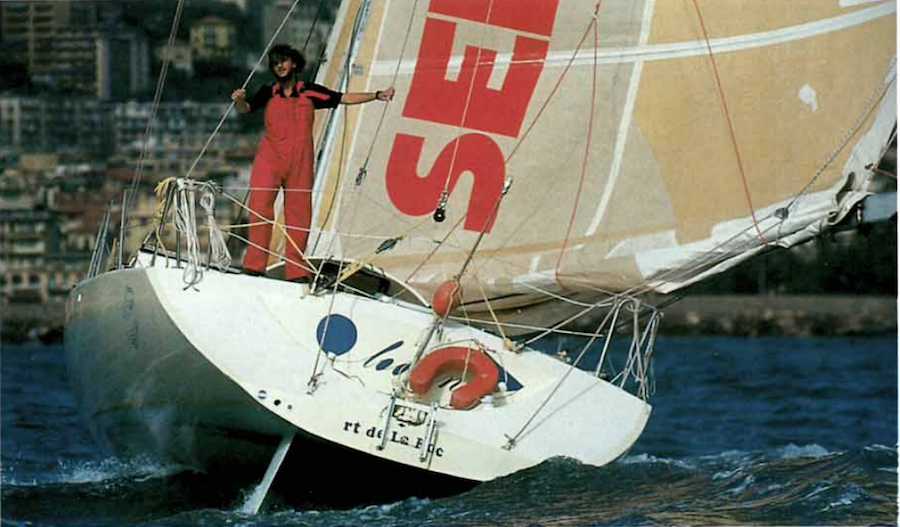
First of all, the exasperated race does not only take place on the race course but starts already on the designer’s table to continue on the construction site. A competition made up of experiences linked by a single goal: the achievement of crazy speeds on the sea with boats that resemble supersonic fighter jets. Made with F1 technologies, more powerful, more futuristic than the now overused “maxis” that race the race around the world with 15 to 20 crew. Some figures help to better understand the potential of Looping compared to a 60′: weight 5 tons vs. 15 of a 60; maximum sail area 320 sq. m. vs. 400 sq. m.; equivalent top speed; running costs reduced to about 1/3. As can be seen, Looping weighs one-third and hoists 20 percent less sail area in load-bearing gaits, a circumstance that enables it to glide much more easily and thus achieve surprising averages. The set of sails for the carrying gaits includes an asymmetrical spinnaker at the masthead, a spi rigged to 7/8 conventional and a storm (storm spinnaker), which has as its initial idea the pen hoisted with the spinnaker cleat and the cleats rigged on the barbs, thus providing for carrying the sail below the forestay. In fact, with increasing speed the bow tends to get heavier, the wave comes up on deck and the time comes to reduce the spinnaker. In close-hauled sails the sail area is divided between the 90 sq. m. of the mainsail and the 40 sq. m. of the jib, which has a 100 percent J, an option this justified by the enormous length of the quartering spreaders that drop the shrouds directly over the side of the boat, thus preventing the passage of any genoa. Since the boat has a very shallow keel, there is a tendency, when sailing into the wind, to reduce the mainsail as little as possible and to use a lot of the luff carriage, which cuts the boat in two; in this, one is favored, as in the large oceanic catamarans, by the adoption of through battens, which, by keeping the profile of the sail stable, allow it to be deflected without flapping, ruining it irreparably. The mainsail staysails are calculated so that with two hands one can tack or gybe without the need of where to intervene in the maneuvering of the flying shrouds.
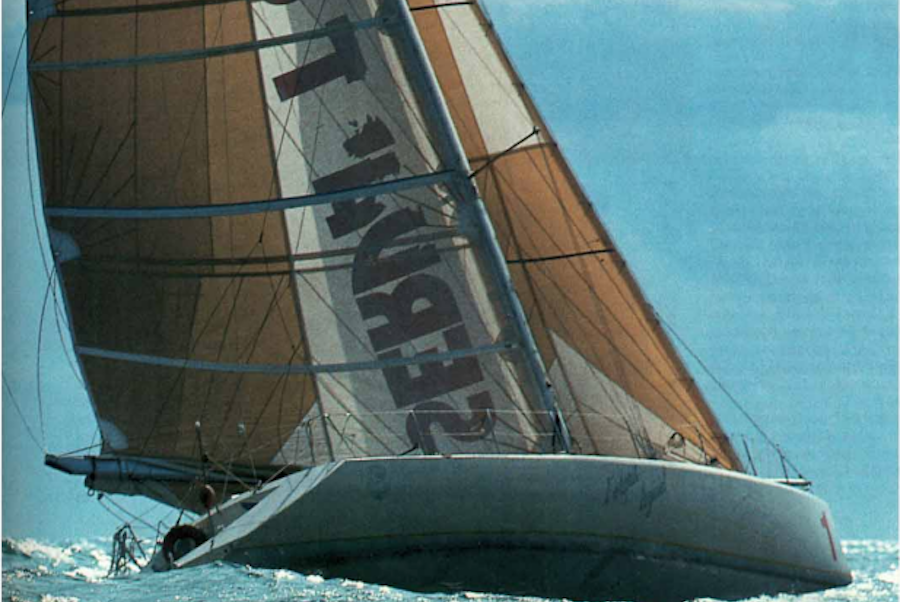
Substantially Looping has a very clean deck following a general trend that makes reliability a priority feature in the design: note the boom attachment at mast foot thus allowing for less stress and strain. The spinnaker also has a working position at deck height thus being able to be used as a bowsprit, a necessity that is imposed in light winds when, with the asymmetrical spinnaker, the apparent wind of great slack from 160° turns to 90° due to the speed created. Below deck, Looping is characterized by absolute minimalism-everything that needs to be carried is placed in the canting table amidships. An aluminum structure then allows sails to be arranged upwind; these weights add to the 700-liter capacity watertight boxes. Water enters by pressure due to speed in five minutes thanks to a counter-periscope that can be lowered to the stern, emptying is done by turning the periscope 180° and thus taking advantage of the direction that is created. This system saves a lot of energy and thus valuable weight.
by Claudio Mazzanti
Check out the latest issue

Michele Molino, nautical engineer with the sea in his vein
On the occasion of the 50th anniversary of the Journal of Sailing, the great excellences of the sailing world tell their stories and reveal their projects. In this column, discover all the companies and people who have made important contributions
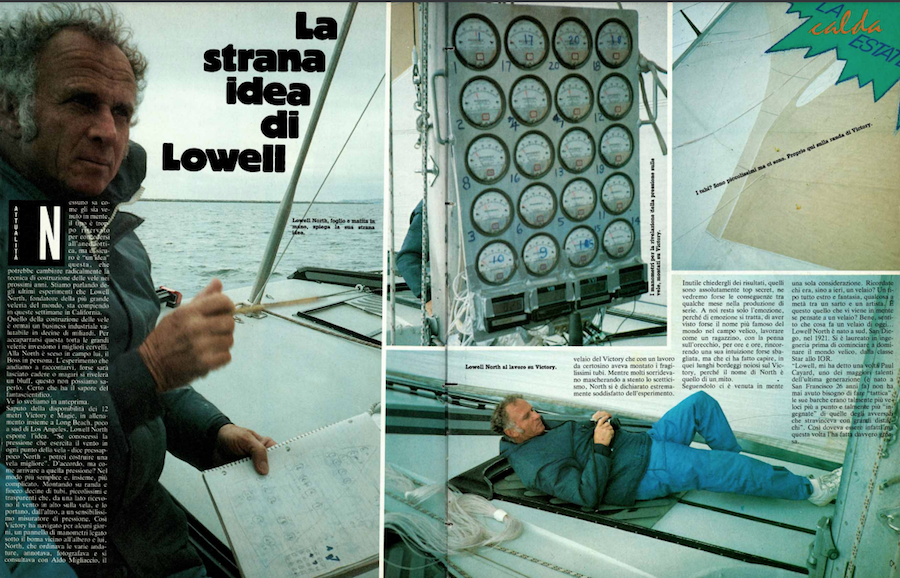
1985. The sails of the future are being born. The GdV is in, with Lowell North
Welcome to the special section “GdV 5th Years.” We are introducing you, day by day, An article from the archives of the Journal of Sailing, starting in 1975. A word of advice, get in the habit of starting your day
Marinedi, the integrated hospitality system
On the occasion of the 50th anniversary of the Journal of Sailing, the great excellences of the sailing world tell their stories and reveal their projects. In this column, discover all the companies and people who have made important contributions
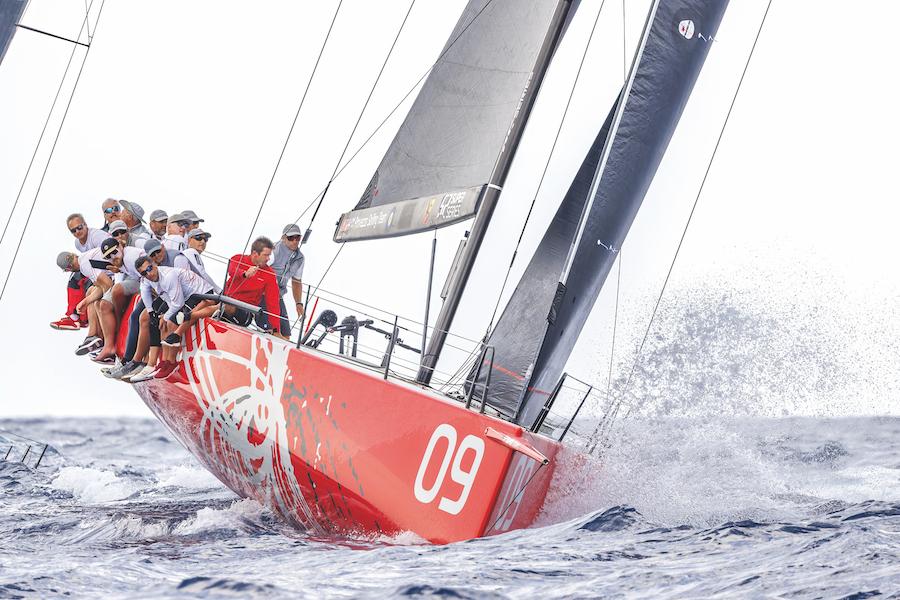
Naval revolution goes through Judel/Vrolijk study
On the occasion of the 50th anniversary of the Journal of Sailing, the great excellences of the sailing world tell their stories and reveal their projects. In this column, discover all the companies and people who have made important contributions

