
Welcome to the special section “GdV 5th Years.” We are introducing you, day by day, An article from the archives of the Journal of Sailing, starting in 1975. A word of advice, get in the habit of starting your day with the most exciting sailing stories-it will be like being on a boat even if you are ashore.
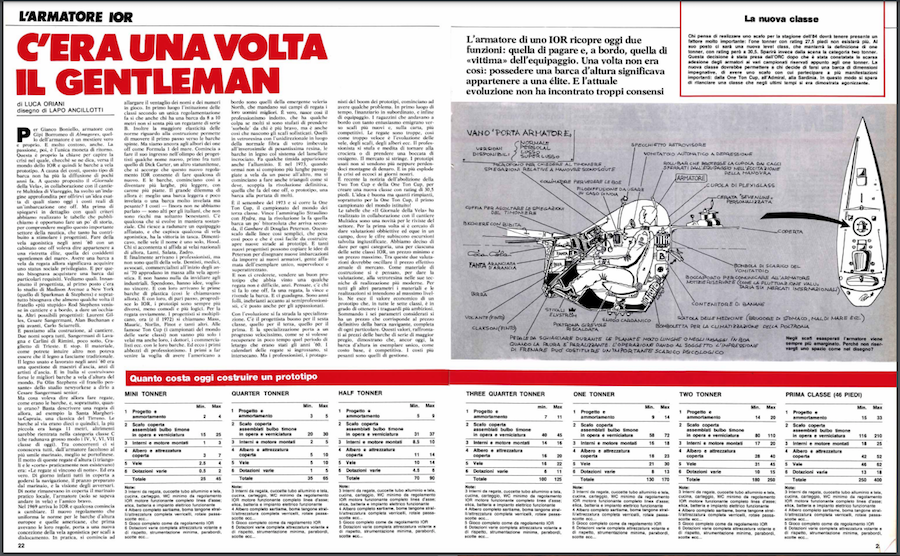
Once upon a time there was a gentleman
Taken from the 1983 Journal of Sailing, Year 8, No. 1, February-March, pp. 22-23
A new profession is born: racing boat owner The 1980s formalized a new profession, that of the offshore racing boat owner. Driven by healthy passion and sometimes by a fever of prominence, shipowners end up being victims of crews, even though they are the ones who “pay.” The Journal reports on the phenomenon and speculates on the “owner’s compartment.” With some healthy irony.

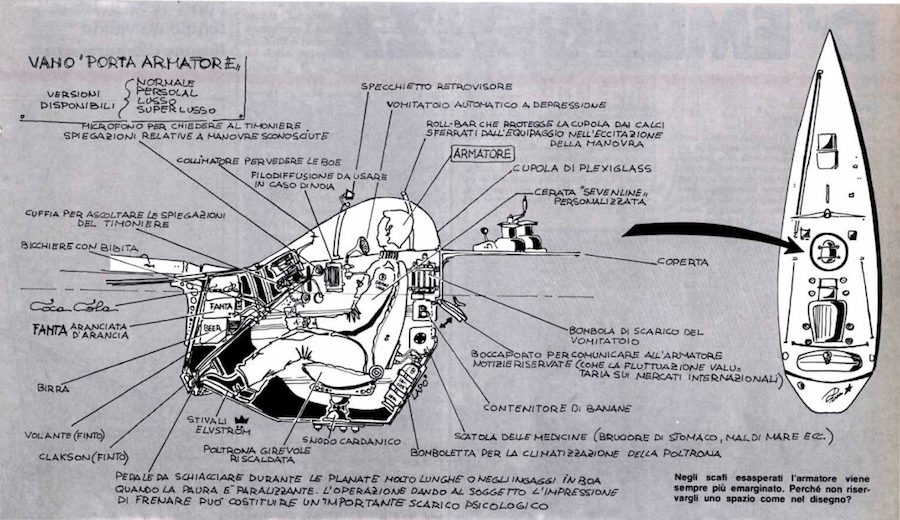
The owner of an IOR today holds two functions: that of paying and, on board, that of “victim” of the crew. It used to be not so: owning a deep-sea boat meant belonging to an elite. And the current development has not met with too much approval.
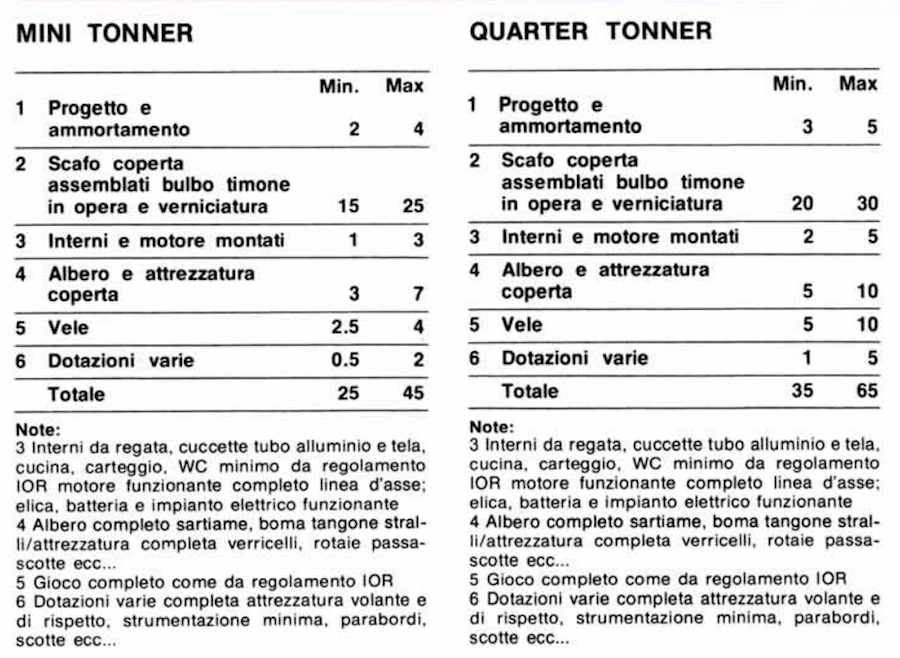
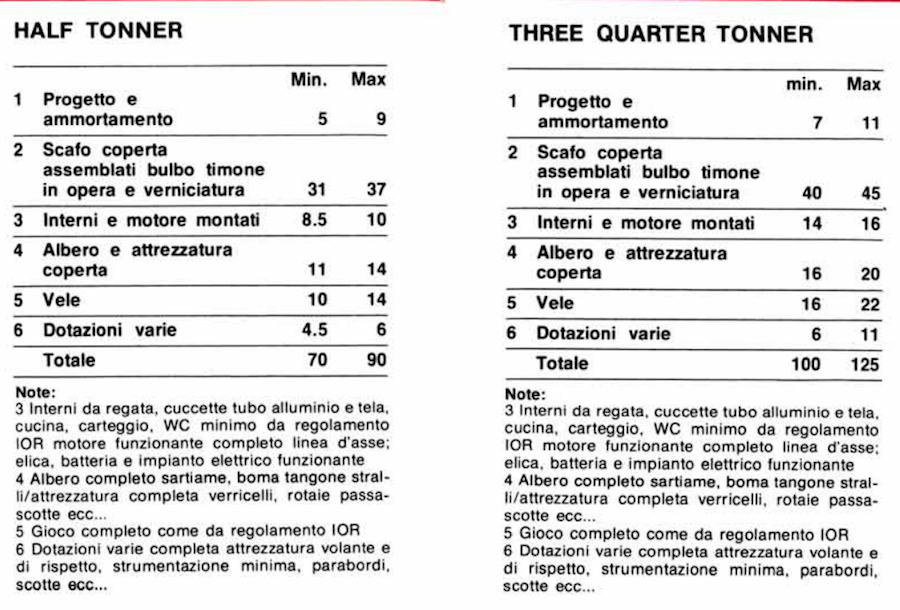
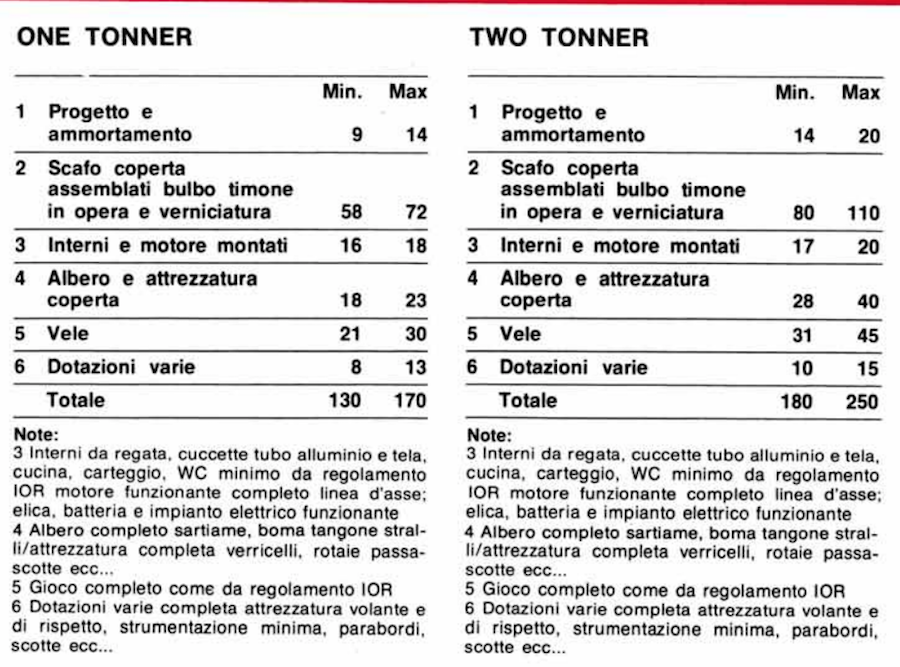
For Gianco Boniello, owner with Gipi Borromeo of Almagores, that of the shipowner is a real profession, and a very expensive one, too.Passion, then, is the only currency of return. This is precisely the key to understanding the crisis in which, whatever one may say, the world of IOR and therefore prototype sailboats finds itself. Because of costs, this type of boat no longer has the popularity of a few years ago. In this regard, the “Journal of Sailing,” in cooperation with the Multidea shipyard in Viareggio, has carried out an in-depth survey to give you an exact idea of what the real costs of a one-off boat are today. But before explaining in detail with which criteria we have made the tables we publish, it is appropriate to do a little history, to better understand this Important sector of boating, which has contributed so much to stimulate designers.
Doing competitive sailing in the 1960s with a one-off cabin cruiser meant belonging to a narrow elite, that of the so-called “gentlemen of the sea,” Having a racing sailboat back then meant acquiring a privileged social status. And for this it was necessary to buy a boat with special requirements. Let’s see which ones. First of all the designer, in first place there was the firm on Madison Avenue in New York (the one of Sparkman & Stephens) and above all it was necessary that at least sometimes the “dumber” brother Rod Stephens came to the yard and on board, to have a look. Other possible designers: Laurent Gilles, Cesare Sangermani, Alan Buchanan, and later, Carlo Sciarrelli. And on to the construction, the shipyard. Two names above all. Sangermani of Lavagna and Carlini of Rimini, just below, Craglietto of Trieste. And stop. The material, as you might guess nothing else could be but traditional planking wood. The wood used and worked in the 1960s was a matter of shipwrights, or rather shipwright artists. And perhaps the best offshore sailboats in the world were being built in Itala. It was Olin Stephens “the thinking brother£ of the New York firm who told Cesare Sangermani senior. But what did he mean then doing regattas, what were the boats like, and more importantly, how many were there? Just describe a regatta of that time, for example the Santa Margherita-Capraia, a Tyrrhenian classic. There were ten or fifteen boats at the start; the smallest was 11 meters long, otherwise it would have fallen into the C class category (which roughly gathered today’s IV. V, VI, VII classes). Among competitors everyone knew each other, from the wealthy owner to the humblest sailor, preferably from Portofino. The motto of these offshore races (triangles and courts practically did not exist) was: “Regattas are won by night.”. And it was true. By day intact everyone on deck enjoying the sailing, the lunch prepared by the sailor, and watching the opponents. At night the local handy sailor, the owner (only if he knew how to sail), and the good friend remained on deck. In 1969 the IOR arrived and something began to change. New regulations unifying the rules for European and American offshore boats, which previously had their own rules, lead to a new understanding of competitive sailing for displacement hulls. In practice, the range of names and numbers involved begins to widen.
First, the establishment of classes under a single set of regulations means that even those with 8- to 10-meter boats no longer feel like second-class racers. In addition, the greater elasticity of regulations regarding construction makes it possible to take the first step toward pushed boats. But we are still in the early days of one-offs as the Formula 1 of the sea. A few new names are beginning to enter the ranks of designers, chief among them Dick Carter, another American, who realizes that this new IOR regulation allows for something new to be done. And boats, thus begin to become wider, lighter, with flatter hulls. The big dilemma at that time is: is it better to have a light boat with little sail or a very sailable but heavy boat? The costs-so far we have not talked about it-are high for the Italians, who are not rich but only well-off. There is something that evolves substantially. Those who can gather a close-knit crew, and who understand something about competitive sailing, have victory in their pockets. I forgot, in sails the name is one, Hood. Those who are content rely on the then national sailmakers, Lami, Salata, Zadro. And finally the professionals arrive, but they are not the sailing ones. Dentists. doctors lawyers, accountants in the early 1970s land in droves in competitive sailing. And they have nothing to envy the industrialists. They spend, they have ideas, they want to win. And with them come the first plastic boats (that’s what they called them then). And with them, hand in hand, the IOR progresses, the prototypes are more and more different, less comfortable and more logical. For racing of course. The designers multiply, now (it is 1972) they are called Mass, Mauric. Norlin, Finot and many others. To the famous Ton Cups (the world championships of the various classes) no longer go only sailors but also they, the doctors, accountants, etc., with their boats. And here are the first sketches of professionalism. The first to get the American on board are those of the up-and-coming sailing company North, who send their best men to the race courses. True, this is how induced professionalism was born, which bears some blame for the fact that many people got tired of taking “sorbole” from those who were better, but it is also how sophisticated hulls were born.
Those in fiberglass with unidirectional instead of the normal fiberglass soaked to the hilt with very heavy resin, the wooden boats with the cross laminated system. Aluminum also makes a few timid appearances. And in 1973, when by then people were no longer making long sailing trips from one country to another, but were also beginning to make triangles properly, the final revolution broke out, the one that made the one off, or prototype, a boat within the reach of many. It is September 1973 and the One Ton Cup. the world championship of the third class is being run. Admiral Straulino wins with Hydra, but the revolution is made by that somewhat lumpy boat that comes in second, the Ganbare by Douglas Peterson. This hull with such simple lines, weighing so little and so easy to build opens up avenues for prototypes. And so many new designers can copy Peterson’s ideas to design new boats to impose on new owners, people hungry for the one-of-a-kind, super-fast, super-equipped specimen. And you won’t believe it, selling a good prototype that has won some kind of regatta is not difficult, quite the contrary. Just think, some people do the one off, do a regatta, win it, and resell the boat. And they make a profit. These are crazy, heady years next to the semi-professionals, there is room for enthusiasts as well. With evolution comes specialization. There is the good designer for the sixth class, the one for the third, the one for the first. And specialization leads to very fast progress, as if to catch up in a short time with the period of lethargy that had been the 1960s. Regatta calendars swell, intersect. But the professionals, the protagonists of the prototype boom, begin to have some problems.
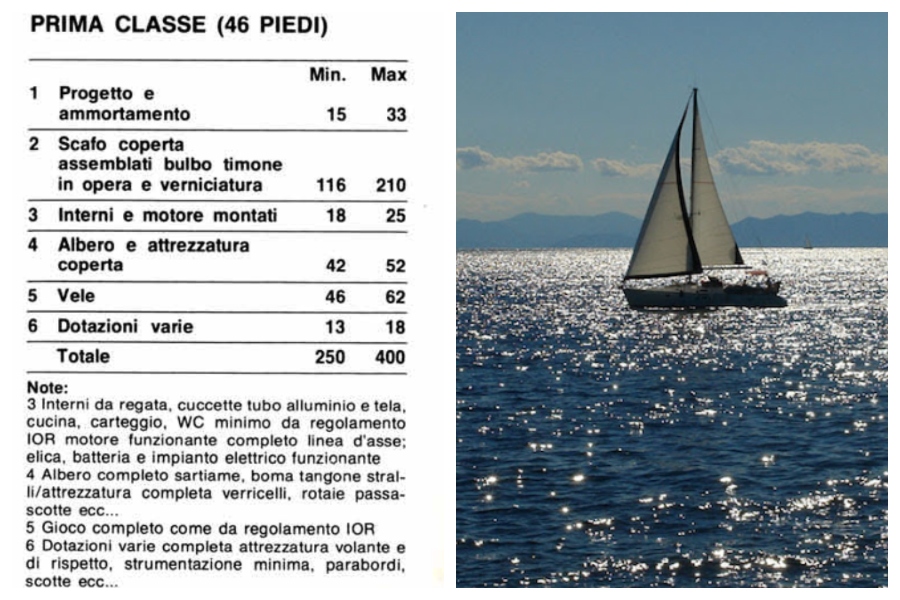
Firstly of time, financially in subordinate, and finally of crew. Kids who used to go aboard with such enthusiasm migrate to newer and, on paper, more competitive hulls. There are too many regattas, just as the evolution of sails, hulls, masts, etc. is too fast. The professional gets fed up and contemplates going back to cruising or taking a breather. The market tightens. Used prototypes no longer sell even losing mountains of money on them. Plus the crisis explodes and here we are in the present day. It is recent news of the abolition of the Two Ton Cup and One Ton Cup to create a new class with 30.5-foot ratings. The idea is good but how many regrets, especially for the One Ton Cup, the first world championship established! The tables that “Il Giornale della Vela” has produced in collaboration with Multidea shipyards are a first for magazines in the industry. For the first time, an attempt was made to give objective and fair evaluations in a field, where figures undergo sometimes unjustified excursions. We have decided to give for each category, one for each of the seven IOR classes, a minimum price and a maximum price, Between these two evaluations should fluctuate the actual current market price As a construction material we have thought, to give the evaluation, of fiberglass in its most modern construction techniques. For all other parameters, materials and fabrications are understood to be at the highest level. This results in the economic value of a prototype that, in all seven classes, is able to achieve the most ambitious goals. Adding up the six parameters considered gives a price that corresponds to the final price of the sailing boat, complete with every detail. These values, compared to the prices of the most valuable production boats, show that, even today, the one-off ocean-going boat, as a base cost, is competitive. The heaviest costs are those of management.
by Luca Oriani
Check out the latest issue

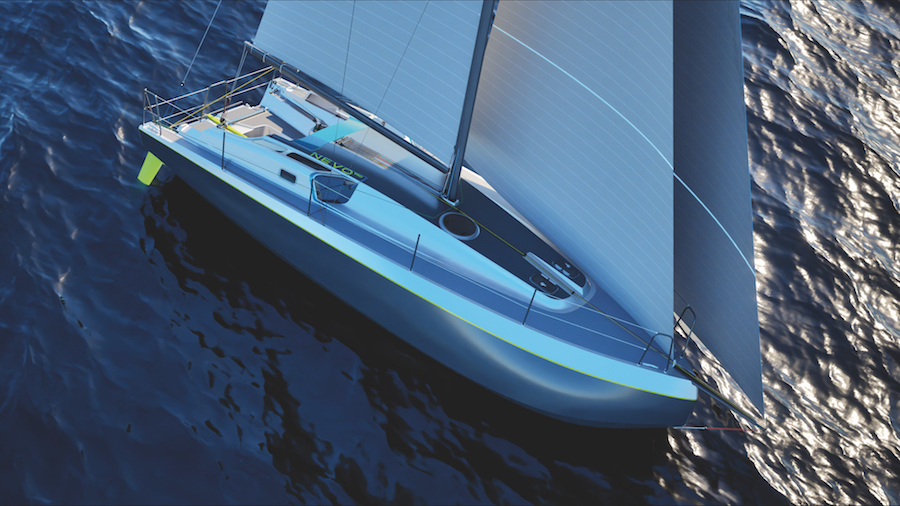
Michele Molino, nautical engineer with the sea in his vein
On the occasion of the 50th anniversary of the Journal of Sailing, the great excellences of the sailing world tell their stories and reveal their projects. In this column, discover all the companies and people who have made important contributions
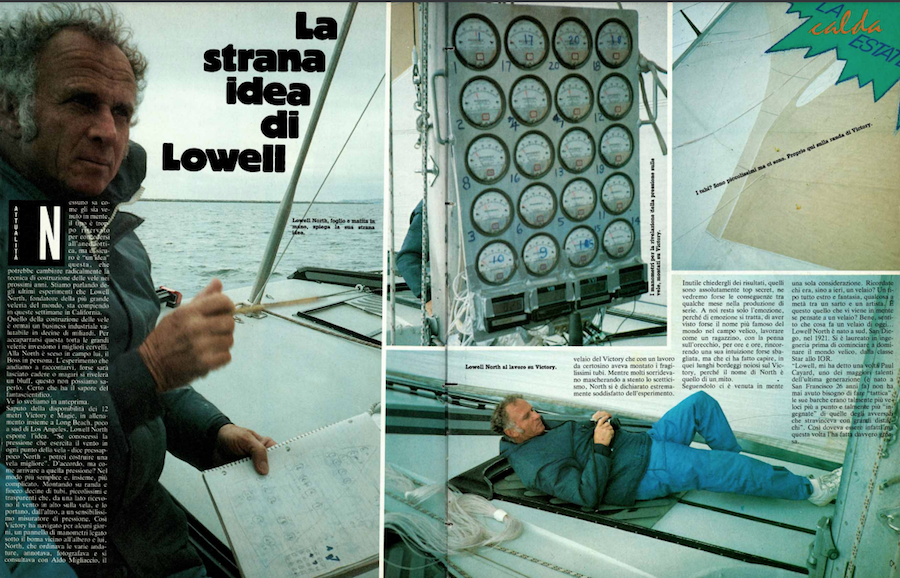
1985. The sails of the future are being born. The GdV is in, with Lowell North
Welcome to the special section “GdV 5th Years.” We are introducing you, day by day, An article from the archives of the Journal of Sailing, starting in 1975. A word of advice, get in the habit of starting your day
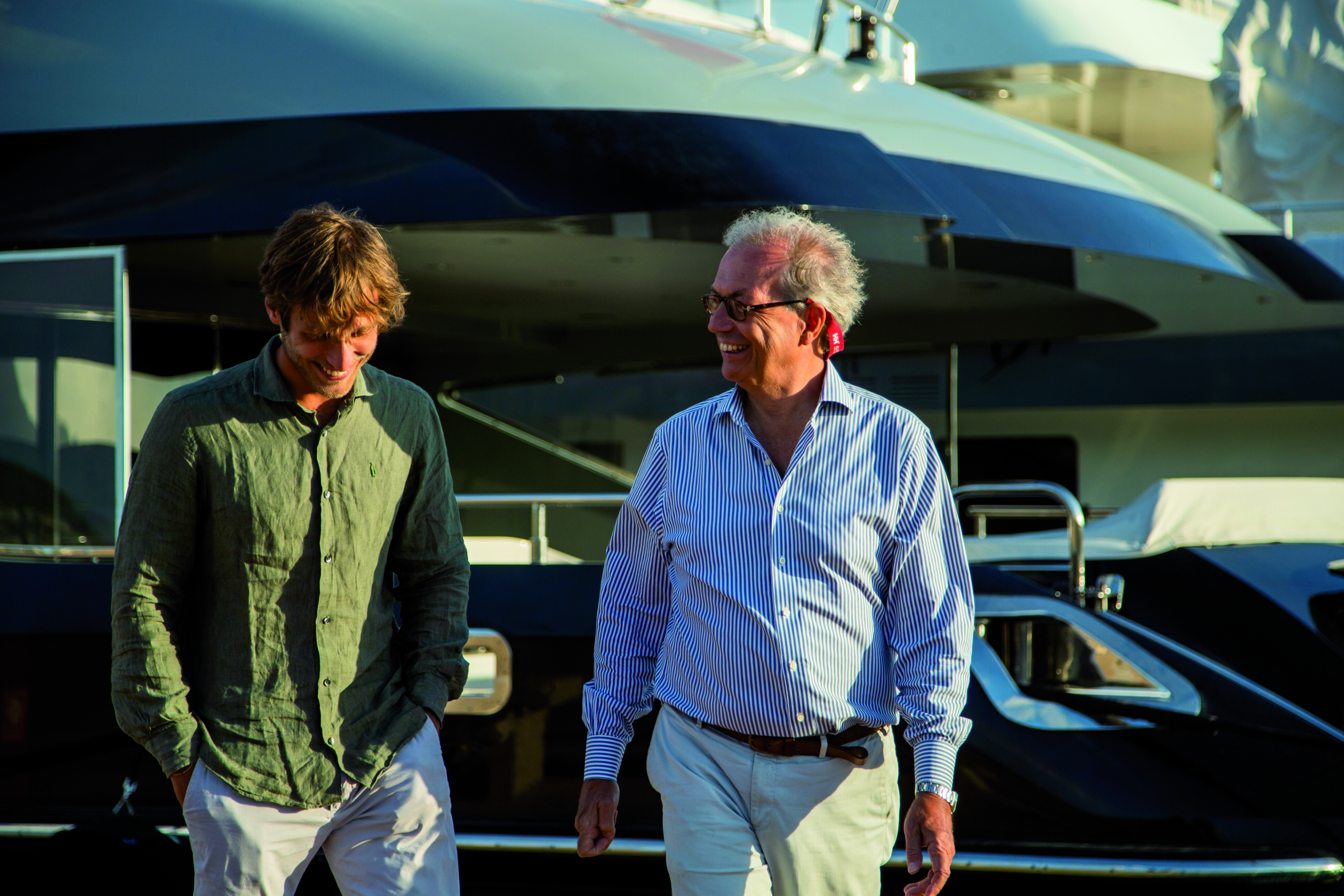
Marinedi, the integrated hospitality system
On the occasion of the 50th anniversary of the Journal of Sailing, the great excellences of the sailing world tell their stories and reveal their projects. In this column, discover all the companies and people who have made important contributions
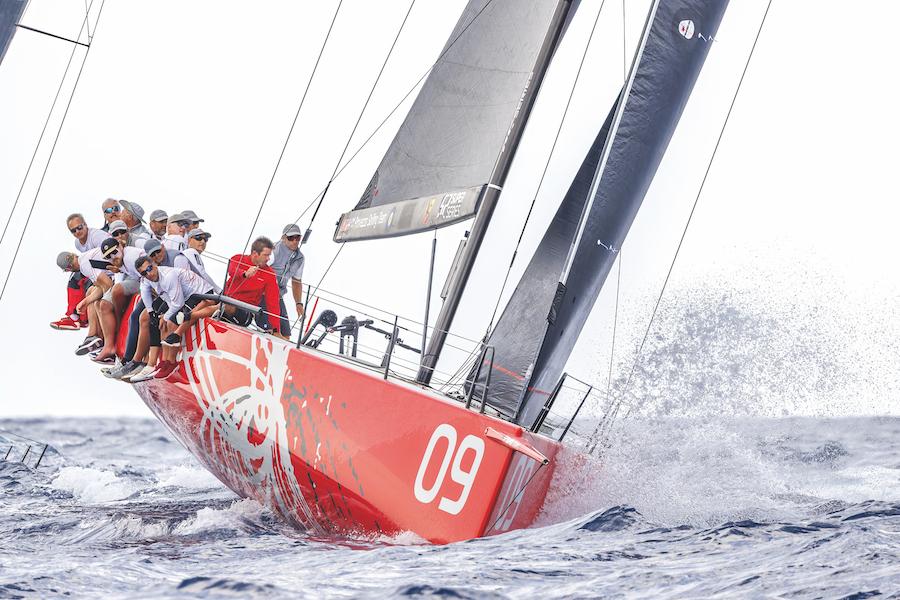
Naval revolution goes through Judel/Vrolijk study
On the occasion of the 50th anniversary of the Journal of Sailing, the great excellences of the sailing world tell their stories and reveal their projects. In this column, discover all the companies and people who have made important contributions

