
Welcome to the special section “GdV 5th Years.” We are introducing you, day by day, An article from the archives of the Journal of Sailing, starting in 1975. A word of advice, get in the habit of starting your day with the most exciting sailing stories-it will be like being on a boat even if you are ashore.
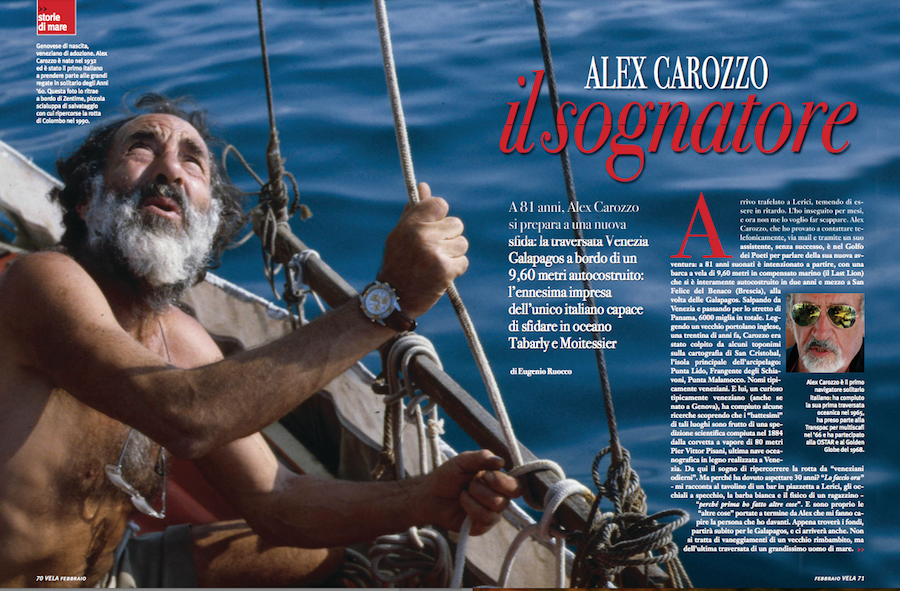
The extraordinary countercultural life of Carozzo
Taken from the 2014 Journal of Sailing, Year 40, No. 01, February, pp. 70-75
Italy’s first solo sailor is named Alex Carozzo. He started in 1965 with a transpacific from Tokyo to San Francisco aboard a boat he self-built in the hold of an American ship. But it was only but the beginning of a series of memorable adventures, which he himself recounts.
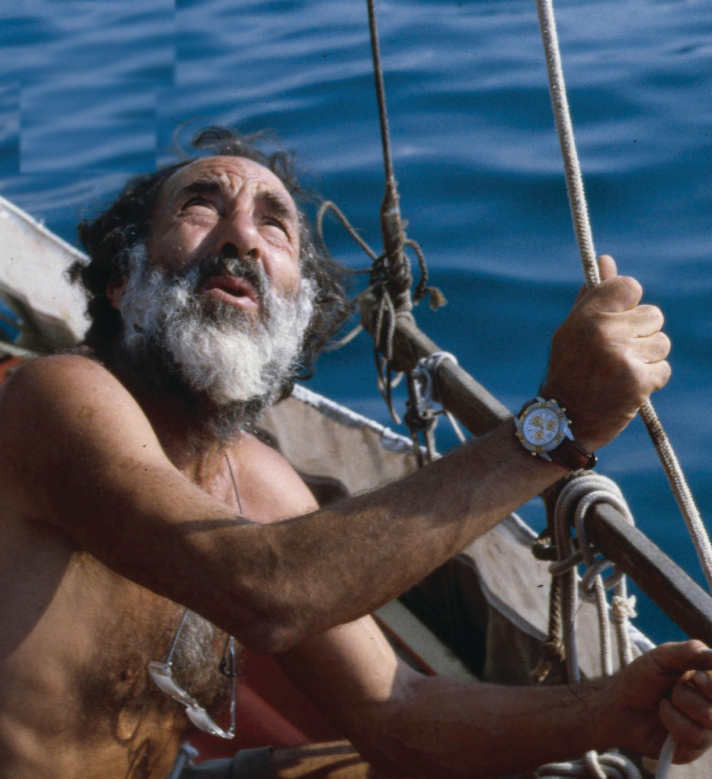
At 81 years of age, Alex Carozzo is preparing for a new challenge: the Venice Galapagos crossing aboard a self-built 9.60-meter: yet another feat by the only Italian capable of challenging Tabarly and Moitessier in the ocean.
I arrive transfixed in Lerici, fearing that I will be late. I have been chasing him for months, and now I don’t want to let him get away. Alex Carozzo, whom I have tried to contact by phone, email and through one of his assistants, without success, is in the Golfo dei Poeti to talk about his new adventure: at 81 years of age, he is intent on setting off, with a 9.60-meter sailboat made of marine plywood (the Last Lion) that he entirely self-built in two and a half years in San Felice del Benaco (Brescia), for the Galapagos. Setting sail from Venice and passing through the Panama Strait, 6,000 miles in total. Reading an old English pilot book some 30 years ago, Carozzo had been struck by some place names on the cartography of San Cristobal, the main island of the archipelago: Punta Lido, Frangente degli Schiavoni, Punta Malamocco. Typically Venetian names. And he, a typically Venetian curiosity-seeker (though born in Genoa), did some research, discovering that the “baptisms” of such places are the result of a scientific expedition carried out in 1884 by the 80-meter steam corvette Pier Vittor Pisani, the last wooden oceanographic ship made in Venice. Hence the dream of retracing the route as “present-day Venetians.” But why did he have to wait 30 years? “I’m doing it now” – he tells me at the small table of a bar in the piazzetta in Lerici, his glasses mirrored, his white beard and the physique of a young boy – “because I did other things before.” And it is precisely the “other things” Alex completed that make me realize the person in front of me. As soon as he finds the funds, he will leave immediately for the Galapagos, and he will even get there. These are not the ramblings of a senile old man, but the last crossing of a very great seaman.
Alex and the Pacific
Alex Carozzo was born in Genoa in 1932, but moved to the Serenissima when he was three years old, where he attended the Nautical Institute and the Naval Academy before joining the Merchant Navy as a course officer. In the 1940s, meanwhile, he had first taken up sailing by attending the Venice Sailing Company, getting on Snipe, Star and 5.50s. ” I did not go to sailing school,” he recounts, “What I know, I learned as a self-taught person. Things, to really learn them, you have to do them; otherwise you end up making serious mistakes “. It is so Alex. Concrete in the soul. In 1965 he became the first Italian solo sailor: he crossed the Pacific, from Tokyo to San Francisco, aboard the Golden Lion, a boat he had built himself during rest shifts and with makeshift tools in the hold of an American ship he was on, the Liberty. The following year he was the only Italian to participate, on the trimaran Tristar, in the first Transpacifica for multihulls (from Los Angeles to Honolulu).
Retirements at the Ostar and Golden Globe.
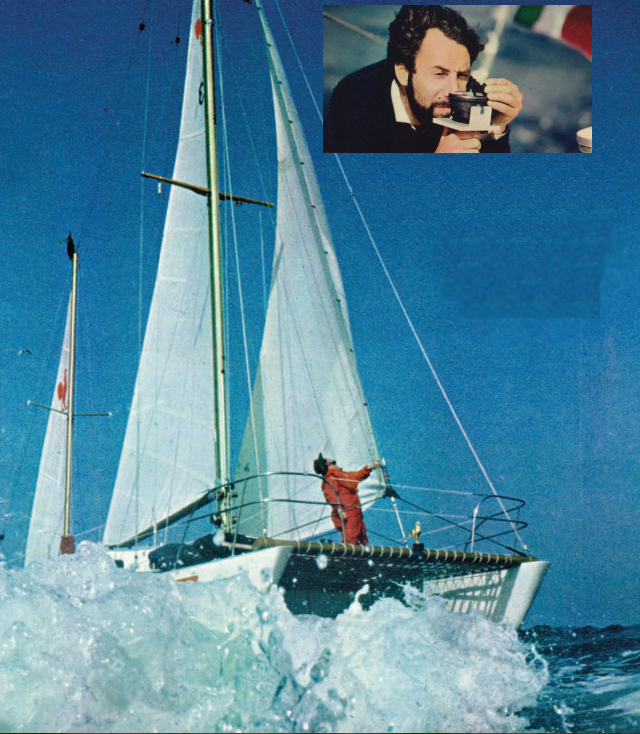
In June ’68 he took part in the third Singlehanded Transatlantic Race (the OSTAR) on the 16-meter catamaran San Giorgio, which he designed and built, starting two hours behind his 34 rivals. The boat, due to financial difficulties resolved at the last moment through the intervention of “L’Espresso,” had arrived in Plymouth not yet perfectly tuned. Despite being listed as one of the favorites, Alex was forced to retire (due to a collision with a whaleboat off Cornwall), a fate he shared with a great “contemporary” of his, Éric Tabarly. He did not lose heart, for in October of that year he was in Cowes, lined up on the starting line of the Sunday Times Golden Globe Race, the historic non-stop solo round-the-world race won by Robin Knox-Johnston after Bernard Moitessier had abandoned the race by heading to Polynesia to find, according to him, himself: “In ’68 I surrendered the St. George, along with some money, to Uffa Fox’s yard in Cowes, and in return I was given the Gancia Americano (the 20-meter Alex-designed with which he took part in the Golden Globe, ed.). All the deck equipment, including the mast, belonged to the St. George: I rigged a 20-meter monohull with what I had salvaged from a 16-meter catamaran. On the first outing, miraculously, everything was in bubble, the boat was a rocket “. If the boat is okay, the same cannot be said of Alex: “In England I was alone, frantically working on the boat: I was exhausted with fatigue, and to make matters worse I had previously had duodenal ulcer surgery. The maximum limit for the start of the race was around October 20, so I had to cross the starting line and stay 10 days out at anchor sorting out the last things on board, in the deep freeze “. When he finally leaves on October 31, along with the ill-fated Donald Crowhurst, who would later commit suicide during the race, Carozzo is sick: “I was not crazy. Simply, I was thinking, I’ll make it. My friends didn’t share my choice but they knew I was going to bring my hide home no matter what, even riding a dunnage “. Alex’s adventure ends on November 14, when he decides to retire by setting course for Porto. The Venetian sailor was the first Italian to take part in the biggest regattas of the century (which at the time seemed to be reserved for the British and French), with boats he designed and, often, built.
An Italian in the court of the greats
In those years, Carozzo was surrounded by true sailing legends such as the aforementioned Chichester, Moitessier, Tabarly, Knox-Johnston and Crowhurst. “I translated Chichester’s book, while in person I met him in San Remo on an evening when no one spoke English (except me, who read English magazines as a child and with vocabulary I taught myself) and they wanted to drag him to the Casino: he came to me and asked me to save him.” Also nice is the little joke he tells me about Donald Crowhurst: ” The only times I have encountered him, he has fallen into the water: at Cowes I went to see him who was moored at anchor, and in getting off the boat to the support craft he fell overboard. Another time the scene repeated itself. Either he was already out of control at that time or I was jinxing him. I remember that he gave me as a gift one of the very first radiogoniometers that his company produced.“. Instead, here is what Alex thinks of the alleged rivalry between Bernard Moitessier and Robin Knox-Johnston (Moitessier claimed that he had retreated to Polynesia to find himself, while Knox-Johnston, some say, claimed that he actually did so because he realized he would get behind him): “This is bullshit from small-time journalists. One has to take one’s hat off to both of them, so different from each other and yet both great: Moitessier was the essence of romanticism and possessed the gift of writing; Knox-Johnston came, like me, from the Merchant Marine: he was thus the embodiment of a certain British-style pragmatism “. Carozzo is less enthusiastic than the other Italian who was making waves at the time, Ambrogio Fogar: “No comment, I’d rather not touch it. I’ve had some rotten blood in my time, I’d rather not repeat it again. Let’s just say that the so-called “characters” I was never close to “.
Carozzo. A leopard (of the sea) can’t change its spots
In 1989 Alex also took away the satisfaction of entering the world of cinema: not as an actor, but as a “shipowner.” In fact, one of his boats was used in the sea scenes of the film “Nostos – Il Ritorno” by Franco Piavoli, a reinterpretation of the Ulysses myth that received positive reviews from critics at the time. The sailing scenes were actually shot on Lake Garda, where Carozzo, a Padenghe resident, has lived for more than 40 years. Alex never gets tired: in 1990 he retraced Christopher Columbus’s route from Gran Canaria to San Salvador: 3,800 miles in forty days, seven more than the Genoese navigator, aboard Zentime, a 20-foot-long fiberglass lifeboat he salvaged from a demolition yard in Las Palmas and put to work in three months. The rigging is more than basic: the rigging is cable abandoned by a crane, the bowsprit a salvaged plank, the deckhouse a one-cubic-meter wooden box. Mainsail and bows are cotton, hand-sewn with the help of a mattress maker. There is no engine, no radio on board, let alone electronic instrumentation; even food is rationed. A primitive form of navigation, a return to the roots for Alex, who in the meantime (the boat’s name, Zentime, literally “the time of simplicity,” also indicates this) has become a Buddhist. He always carries a statue on board, which he calls “The Master,” his source of inspiration while sailing. The adventure is recounted in his book, Zentime Atlantico, published by Nutrimenti. In ’93, aboard a “topo,” a small traditional boat from the Adriatic area, he again made the Atlantic crossing.
The gale and the mother’s dream
I can’t help but ask Alex, who has been through a lot at sea, if he has ever been in a situation where he risked his skin: “It was October ’65 and I was in the middle of the Pacific when I was hit by an abnormal depression, with the barometer having suddenly gone down. An unprecedented gale was coming, complete with giant breakers. I prepared the boat for the worst, lowering the sails and placing the stern anchor. ‘This is it,’ I muttered to myself. I was scared, but then I calmed down: I thought that in the end, everything I could have done to save myself I had done. If there had been a Tabarly or a Moitessier in my place, it would have been the same. It made me angry to think how my friends would have reacted to the news of my death: ‘Look at the Alex, he was a jerk and went down like a pear.’ That’s the sailor’s pride: feeling like a victim of unfair judgment. Fortunately, the storm passed, the boat weathered the waves, and I got away with it. When I returned home, my mother and sister told me that on October 16 they had both had a nightmare. My mother had dreamed of me dressed in a black palandrana and in need of help, my sister imagined me at the base of a large sand mountain as I tried to reach the summit. October 16 was exactly the evening when I was hit by the gale.“. And now, dear Alex, all we have to do is wait for your next “darling.”
Eugene Ruocco
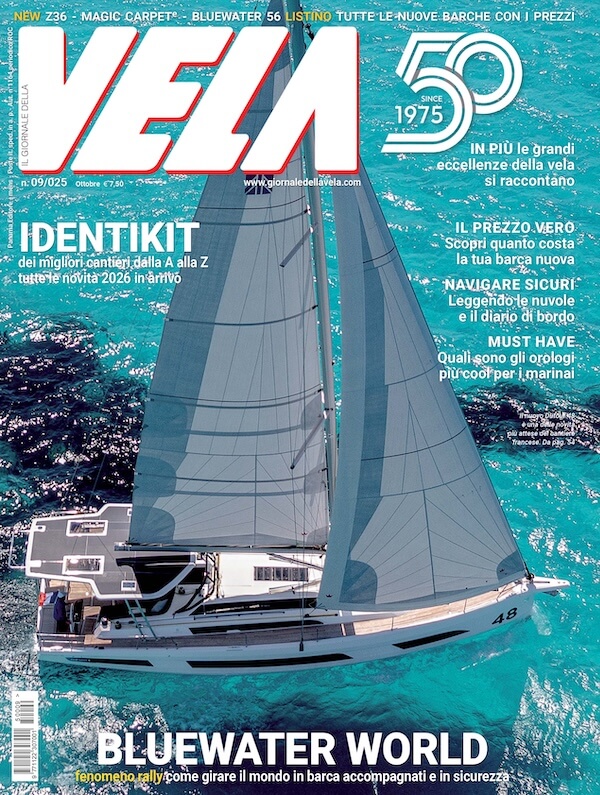
Check out the latest issue

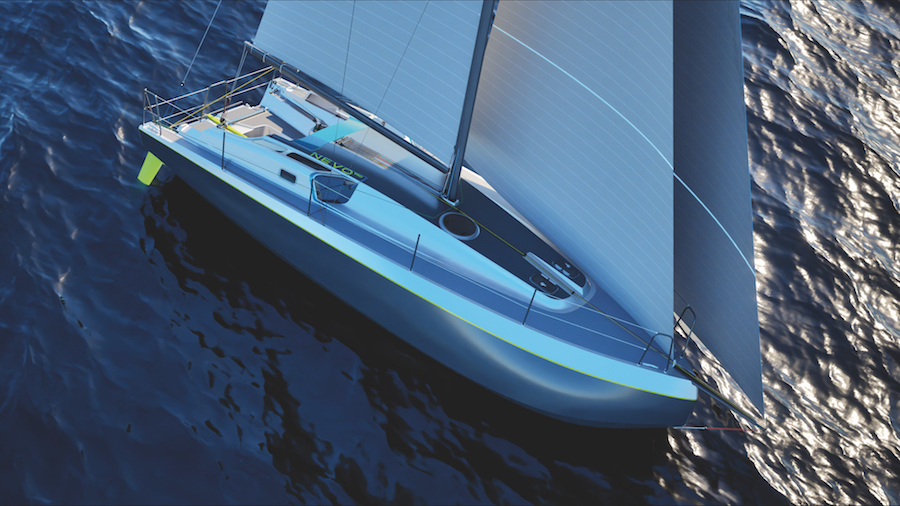
Michele Molino, nautical engineer with the sea in his vein
On the occasion of the 50th anniversary of the Journal of Sailing, the great excellences of the sailing world tell their stories and reveal their projects. In this column, discover all the companies and people who have made important contributions
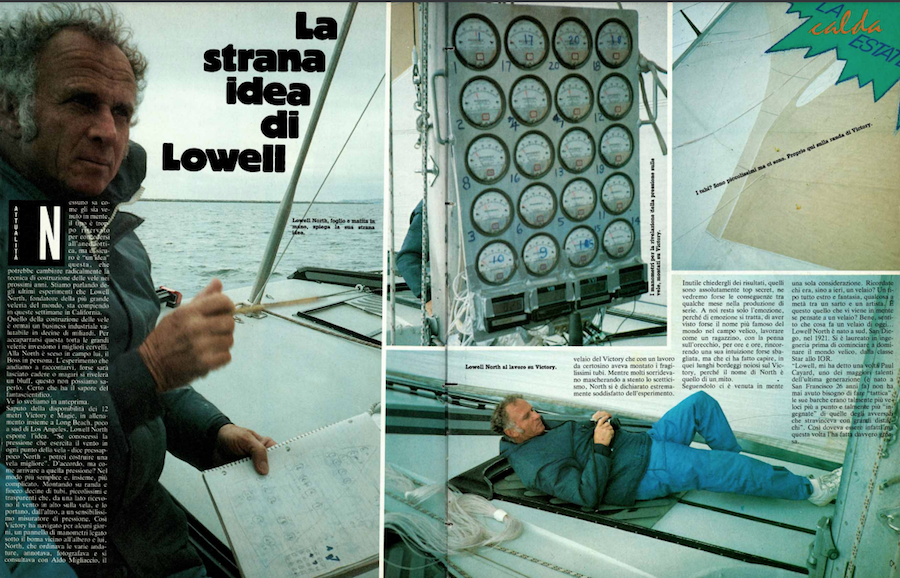
1985. The sails of the future are being born. The GdV is in, with Lowell North
Welcome to the special section “GdV 5th Years.” We are introducing you, day by day, An article from the archives of the Journal of Sailing, starting in 1975. A word of advice, get in the habit of starting your day
Marinedi, the integrated hospitality system
On the occasion of the 50th anniversary of the Journal of Sailing, the great excellences of the sailing world tell their stories and reveal their projects. In this column, discover all the companies and people who have made important contributions
Naval revolution goes through Judel/Vrolijk study
On the occasion of the 50th anniversary of the Journal of Sailing, the great excellences of the sailing world tell their stories and reveal their projects. In this column, discover all the companies and people who have made important contributions

