
Welcome to the special section “GdV 5th Years.” We are introducing you, day by day, An article from the archives of the Journal of Sailing, starting in 1975. A word of advice, get in the habit of starting your day with the most exciting sailing stories-it will be like being on a boat even if you are ashore.
The secret life of great designers
Excerpted from the 1980 Journal of Sailing, Year 6, No. 10, November/December pp. 48/49 and pp. 52.
The Stephens brothers, Gary Mull, and Doug Peterson were the fathers of modern sailboats. The Sailing Newspaper reports on their professional and private lives. It all stemmed from a passion for sailing, then everyone had their own winning idea.
This is the first part of a series of articles about the lives, design line and ideas of some of the greatest naval designers of our time. We begin with Olin Stephens, the wizard of the America’s Cup, Gary Mull, a very imaginative designer, and Douglas Peterson, considered the most important and valuable designer of the IOR fleet of boats today.
Sthepens
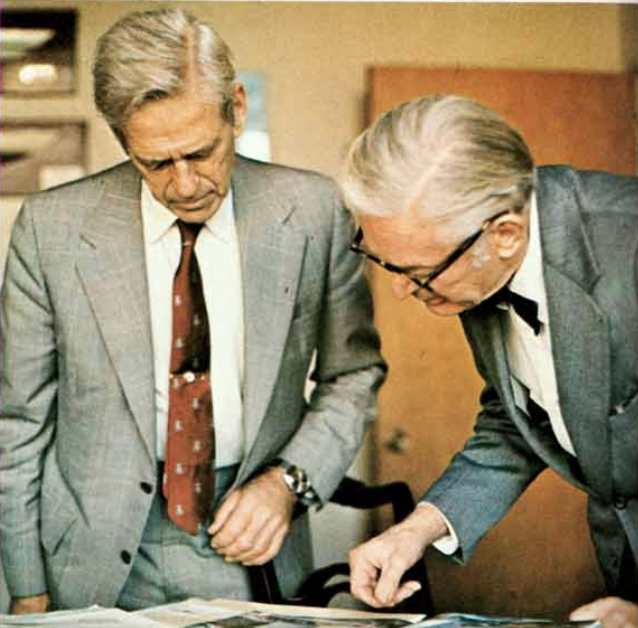
Born in 1908 in New York City, Olin James Stephens II graduated from Hillsdale High School with a degree in architecture. His career as a naval architect began in 1928 when he decided to join in partnership with Drake Sparkman, thus starting the design firm that later became the progenitor of yachting design. Olin’s father, who is an avid yachtsman, commissions the firm Sparkman & Stephens to design a small yawl, with which to participate in the 1931 Transatlantic Regatta: construction is contracted to the Minnefords shipyard on City Island. Thus was born the legendary Dorade. Rod Jr., Olin’s younger brother, is given the task of supervising the construction. Already from the first outings at sea, Dorade proves to be an almost unbeatable boat, collecting one success after another. But it is by winning the Transatlantic Regatta that Dorade establishes itself definitively. The secret to the boat’s speed lies mainly in its small wetted surface area and a slightly larger maximum beam than the boats in vogue at the time. After the Dorade it is the turn of Stormy Weather, another two-masted for which Olin Stephens proposed new ideas, such as a further increase in width and a significant reduction in hull weight, resulting in a boat that is very fast and internally more spacious than its rivals. The Stephens era has now begun, and some of the most famous designs to come out of the 79 Madison Avenue studio include: Baruna, Blitze, Gesture, Bolero, Kialoa II, Lightining and the revolutionary yawl Finisterre, which won the Bermuda Race three times in a row. For the last America’s Cup challenge, raced on J-class boats, Stephens Studio is chosen as a consultant to designer Starling Burgess to build the American Defender. The result is Ranger, a 4-0 winner against the British contender Endeavour II.
The year is 1937. With the return of peace a the conclusion of World War II. yachting resurrects and resumes old and new classic competitions. The six-, eight- and 12-foot categories regain popularity, and Sparkmar & Stephens “designs turn out to be even better. Therefore, the two architects are chosen to design the new America’s Cup defender for the 1958 challenge and Columbia wins by 4 to vs. the British Sceptre, The New York firm is now in the history of world yachting. Olin Stephens, who is in charge of design, and his brother Rod, who is an expert in technical and construction, are now the winning combination, and designs for the most prestigious yachts continue to emerge from their work tables. In 1964 it is again the America’s Cup that confirms Olin as the wizard of 12 meters. It is in fact his Constellation, skippered by ace Bob Bavier, that comes out on top against challenger Sovereign. Since then, the prestigious Hundred Guineas challenge has been a monopoly of Stephens” designs: in both 1967 and 1970 he won Intrepid, in 1974 and 1977 Courageous and in the 1980 edition, just finished, Freedom. Around 1967, a new architect appears in the U.S. firmament who proves to be very competitive: he is Dick Carter. Thus began then a real duel between the two designers to vie for supremacy in the yachting industry. Stephens seems to be on the wane, but here it is with the making of such fine yachts as the Italian Levantades first and Mabelle then, the Madison Avenue studio regains momentum. Mabelle, in particular, can be considered as the first boat designed in view of the advent of the IOR regulations. In the first year of racing in fact Mabelle, racing with RORC tonnage, raced in the first class, but the following season, with the new rules that Olin himself dictated as president of the ORC, she moved to the second class. Thanks to this year’s advance knowledge of the new rules Stephens remains virtually unrivaled.
In the 1970s the firm, consisting of some fifteen draughtsmen and technicians, is the world’s most renowned practical design school, and it was from those offices that some young architects of the caliber of German Fres, Gary Mull, Scott Kaufman and many others emerged. With the advent of young designers Stephens loses much of the IOR market, so he decides to turn his attention to the design of production boats, first among them the Swan range, and large Zero class. including the famous Kialoa III. It is now a year since the protagonist of fifty years of yachting retired from active design life. Leaving the management of Sparkman & Stephens Inc. in the hands of such talented men as young Alan Gilbert and Italian-American Mario Tarabocchia, the old master lives in Vermont.
Mull
Born in the United States in 1937, Gary Mull can be regarded as the most imaginative naval architect among the “greats.” Having graduated in engineering from the University of Berkley, California, with a thesis on naval architecture, Mull immediately began his own design work but, getting poor results, decided in 1964 to start an internship. He was hired at Sparkman & Stephens, the most famous and prestigious firm in the world. That very year Gary works together with the America’s Cup “wizard” on the design of the 12-meter Constellation, which will be the winner and on which Mull embarks. After a year’s apprenticeship in New York, Gary Muli returned to his native California where, while dabbling in designing IOR boats, he worked first at Lockeed Ship and then at Pacific Coast Engineering. The turning point came in 1967 when, denied a permit by Pacific Coast to participate in the Star World Championship as bowman to Tom Blackhaller, he quit his job and opened his own studio. His first accomplishment proved to be very competitive and, in a short time, Gary enjoyed considerable success. His most famous boats are: The Force of Destiny, Lively Lady, Dora, Munequita (prototype of the successful Ranger 37 series) and Improbable.
It was not until 1974 that the California architect designed his first level-class boat: it was the three-quarter ton Swampfire, which won the world championship that year. For this boat Mull experiments with a new theory of his own: lighter displacement, flatter planing hull with a major sail plan. In the wake of Swampfire, Gary designs another boat with exceptional speed qualities: the Deception.
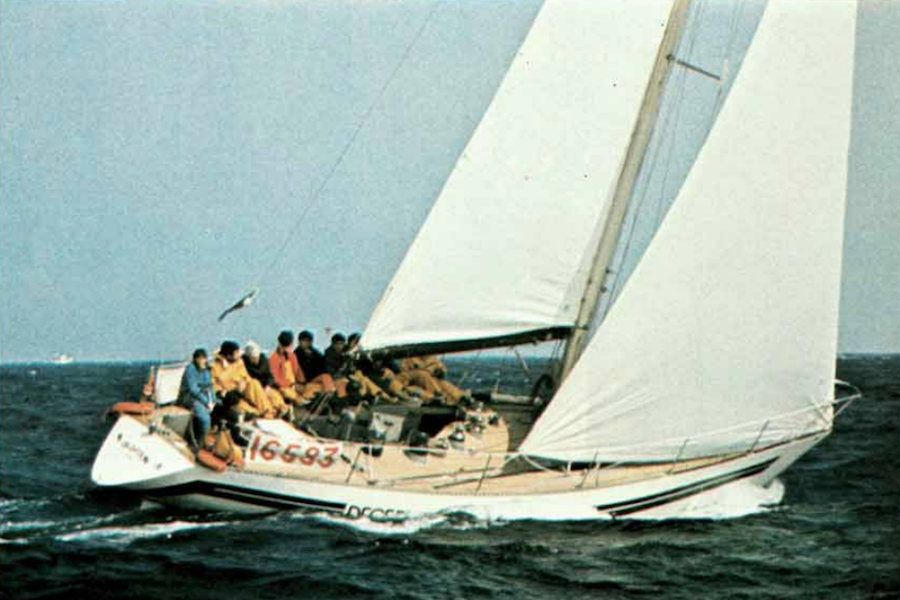
This second class was built in Italy at the Gennari shipyards in Pesaro for the Turin-based Vanni Mandelli and achieved major successes. At this point Mull’s design line changes substantially and a series of very extreme and unconventional designs are thus made, such as the U.S.-based two-tonner Gonnagithca and the first-class Vanina (also for Mandelli). But the results this time not only lived up to expectations. In fact, the shortening of the waterline and the adoption of forward, but especially aft, momentums of considerable size make his boats behave well in light winds and calm seas, but also a considerable loss of speed as soon as the wind and sea increase. This causes him to revolutionize his design line again. Indeed, he tries different solutions, using both heavy and light displacements, and the latter seem to be more congenial to him. The excellent performance of the one-tonner Hot Flash demonstrate this. Gary Mull, besides being a good architect, is also a very good sailor.
Peterson
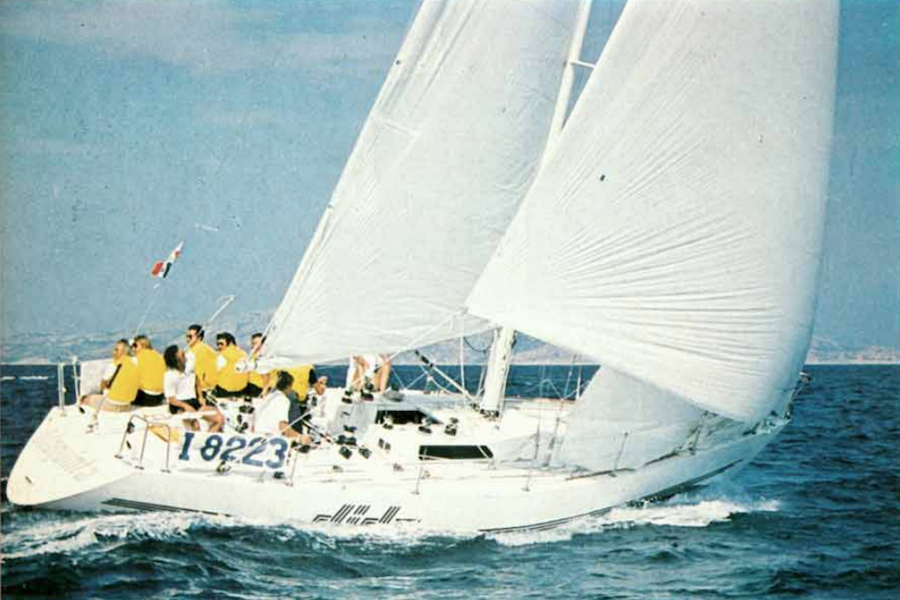
Before 1973 Douglas P. Peterson was known only as a good racing crew member, one of many. But in 1973, when he designed Ganbare (meaning luck in Japanese) everything changed for him. But not only for him: in fact, his design revolutionized the yachting design line. His success has lasted ever since. Douglas was born in Los Angeles in 1944 into a traditional family and seemed destined for a quiet middle-class life when a heart attack struck his father and led the family doctor to advise Peterson Sr. to devote himself less to work and more to an altogether restful activity: sailing. And so it is that Doug at age 12 accompanies his father on a large sloop that is considered more medicine than fun. At the age of 15, Peterson began racing aboard Legend, a 50-foot sloop designed by Skip Calkins (then considered a revolutionary architect), a boat with long waterlines and rather short drafts. Through the great friendship that develops between Doug and the designer, the young crewman falls in love with the whole mysterious world of design.
The next few years are spent by the young Californian between boats, between relocating and racing, between visiting a shipyard and taking a course in mechanical engineering. But a dark cloud awaits him on the horizon: the Vietnam War. After eight months on a military boat along the Indochinese rivers, Doug returns to the United States and begins working for the Kiscaddon family as a sailor. During this time he met Ron Holland (now a designer) and Bill Green (director of the Jeremy Rogers shipyard and his agent in England). A sincere friendship developed between the three, and it was thanks to Bill Green that the future star of modern yachting entered the design studio of Dick Carter, the most fashionable architect of the day.
In 1971 he met and married a young Japanese woman named Eiko. A year after marriage, Peterson decided to start his own business and, thanks in part to financial help from his paternal grandmother, built his first “personal” boat: Ganbare. This one-tonner, built at a bargain price by Carl Eichenlaub’s shipyard, turns out to be very unconventional, adopting a light displacement, a bulbous and a very fine-profile rudder. Ganbare, to tell the truth, looks rather odd in its lines, so no shipowner in and around San Diego is willing to help the young architect. Doug is therefore forced to call some of his friends, including Holland and Green, into the crew. After a second-place finish at the North American championships, which also counted as a One Ton Cup selection, the small boat, only 10 meters 84 long, is ready for the big challenge in the waters of Sardinia against the multi-decorated designs signed by Carter and Stephens. Ganbare did not win the One Ton, it was only bad luck that denied him the world title, but his incredible performance propelled the Californian Peterson into the design Olympus. Since that day the successes of his boats have not been counted, and to this day they remain the designs to beat. But what did Peterson change in design? First, Doug started from ideas opposite to those of Carter and Stephens, who were making very heavy and wide boats to make the most of the regulations, preferring to have smaller hulls with less sail but much lighter hulls with full U-shaped bow and stern sections with no slop, in order to achieve not only excellent speeds, but above all a nearly perfect passage over the wave, avoiding harmful pitching to a minimum. Peterson is also credited with being the first to thoroughly study the problem of weight concentration, especially in hull construction. From 1973 to the present, the evolution of his design line has always been constant, never suffering exaggeratedly from the influences of new theories (see Farr-type superlight displacements and New Zealanders) but demonstrating, as in the case of the one-tonner B 195, that he could fight on equal terms even in a design line he did not prefer. It was in 1978 and precisely with two Italian boats that the now undisputed “baron” of design made major changes to his designs. For Dida V e Yena II, Peterson abandons his classic triangular sterns, his fine bow entries, and opts for much more load-bearing boats than his predecessors, with rather swollen bow sections, very full sterns, and large sterns. The idea immediately proves to be a good one, so much so that Dida V wins the Sardinia Cup and Yena II takes third place. Douglas B. Peterson has now won it all and continues to win, but his ultimate goal has yet to be achieved: designing a 12-meter International Tonnage.
Mauro Uggè
Check out the latest issue

Michele Molino, nautical engineer with the sea in his vein
On the occasion of the 50th anniversary of the Journal of Sailing, the great excellences of the sailing world tell their stories and reveal their projects. In this column, discover all the companies and people who have made important contributions
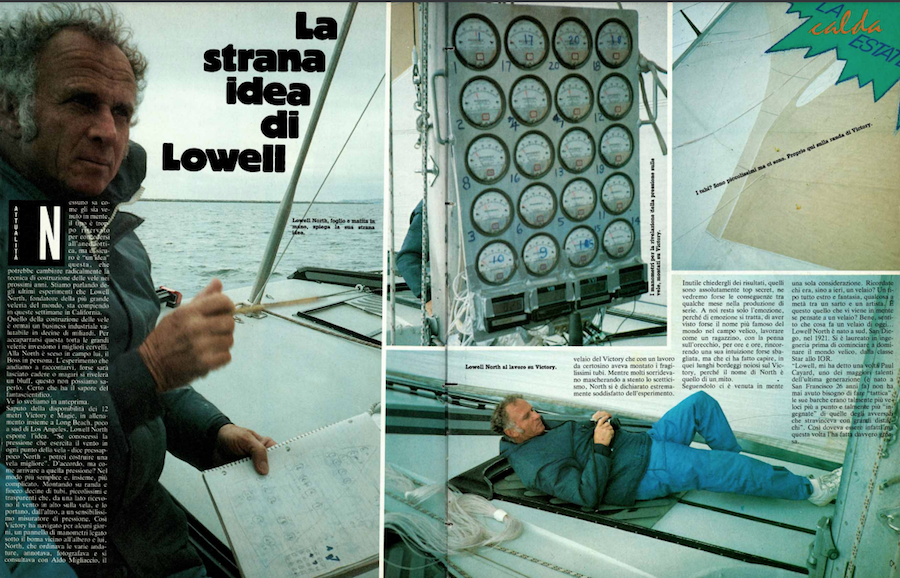
1985. The sails of the future are being born. The GdV is in, with Lowell North
Welcome to the special section “GdV 5th Years.” We are introducing you, day by day, An article from the archives of the Journal of Sailing, starting in 1975. A word of advice, get in the habit of starting your day
Marinedi, the integrated hospitality system
On the occasion of the 50th anniversary of the Journal of Sailing, the great excellences of the sailing world tell their stories and reveal their projects. In this column, discover all the companies and people who have made important contributions
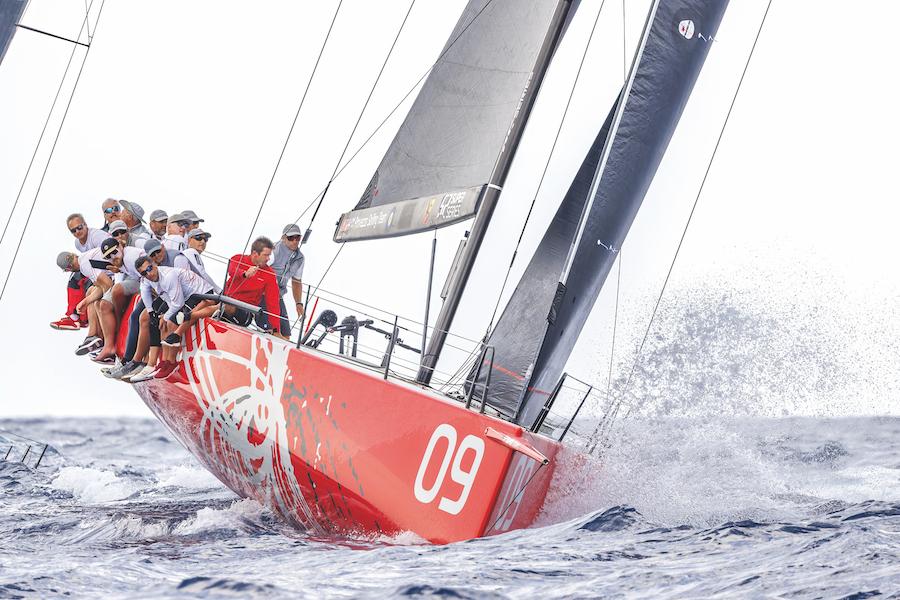
Naval revolution goes through Judel/Vrolijk study
On the occasion of the 50th anniversary of the Journal of Sailing, the great excellences of the sailing world tell their stories and reveal their projects. In this column, discover all the companies and people who have made important contributions

