
Welcome to the special section “GdV 5th Years.” We are introducing you, day by day, An article from the archives of the Journal of Sailing, starting in 1975. A word of advice, get in the habit of starting your day with the most exciting sailing stories-it will be like being on a boat even if you are ashore.
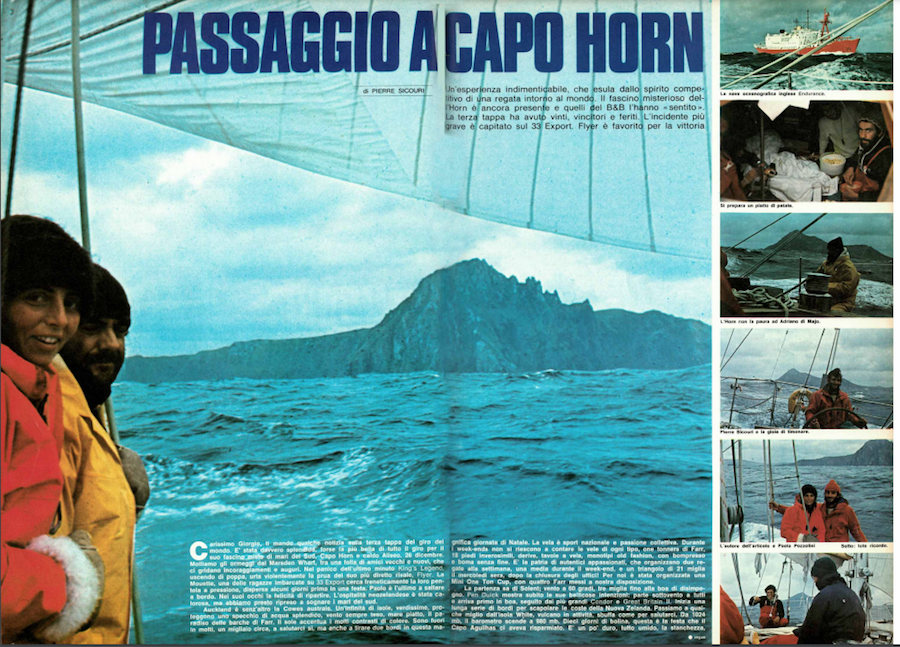
Passage to Cape Horn for ten adventurous Italians
Cape Horn. Taken from the 1978 Journal of Sailing, Year 4, No. 2, March/April, pp. 28/30.
The great sailor Pierre Sicouri recounts the passage to Cape Horn and the adventurous sailing of B&B, the Italian boat participating in the Tour of the World. On board are ten boys in their early twenties who will become famous.
An unforgettable experience outside the competitive spirit of an around-the-world regatta. The mysterious allure of the Horn is still there and those at B&B have “felt” it. The third leg had winners, losers and injuries. The most serious accident happened on the 33 Export. Flyer is favored for victory.
Dearest George, I am sending you some news about the third stage of the world tour. It was truly splendid, perhaps the most beautiful of the whole tour because of its mixed charm of South Seas, Cape Horn and warm Trade Winds. Dec. 26: We cast off our moorings from the Marsden Whart, amid a crowd of friends old and new, shouting encouragement and good wishes. In a last-minute panic King’s Legend, going out astern, violently bumps the bow of her most direct rival, Flyer. La Mouette, one of the girls embarked on 33 Export frantically searches for their pressure cooker, lost a few days earlier at a party. Paul is the last to jump aboard. In his eyes is the happiness of setting off again. New Zealand hospitality has been warm, but we soon resume our dreams of the South Seas. Auckland is certainly the southern Cowes. An infinity of islands, verdant as they are, shelter a splendid body of water, wind always tense, sea flat, Farr’s boat paradise. The sun accentuates the many color contrasts. Many are out, a thousand or so, greeting us yes, but also pulling two edges on this magnificent Christmas day. Sailing is a national sport and a collective passion. On weekends you can’t count the sails of all kinds, Farr’s one-tonners, 18-footers unheard of, dinghies, sailboards, old-fashioned monotypes with endless bowsprits and booms. It is home to genuine enthusiasts, who organize two regattas a week, an average one on weekends, and a 21-mile triangle on Wednesday evenings after the offices close! A Mini One Ton Cup was organized for us, with four Farrs placed at our disposal. The start smacks of Solent; 60-degree wind, three miles to the disengagement mark. Pen Duick immediately shows his warlike intentions: he starts downwind of everyone and arrives first at the buoy, followed by the larger Condor and Great Britain II. He begins a long series of edges to scape the coast of New Zealand. We pass a few miles from White Island, the active volcano, puffing as if to greet us. From 1024 mb, the barometer drops to 980 mb. Ten days upwind, this is the feast that Cape Agullhas had spared us. It is a little hard, all damp, the fatigue, the “windward slack”, the difficulty of cooking.
For new people, it’s quite a baptism!
In the barometer rise, the wind is blowing strong from the SE. 45-50 knots for 36 hours. A little too much for our taste. Big tormentor and three hands, hard seas on deck, 50 degrees from the wind, the boat punishes a bit, actually, and gives big beats in the waves. We on the second leg, recognize in the dark, steep, breaking sea the power of the great South. For the new guys, it’s quite a baptism! The mainsail rips three times, always patched up, on the fourth we hoist the mainsail, which has lost all ridiculousness, and pulls beautifully. The superlight boats, Gauloises and 33 Export put masts in the water several times. 33 Export will tell us of capsizing at 170 degrees, batteries coming off their seats, and unbelievable chaos in the cabin. Marie -Laure, caught in a wave at the helm, is dragged overboard. She is left hanging by her seat belt and quickly hoisted aboard. Passing Greenwich meridian, the date is pushed back a day and we experience the same day twice. Funny, isn’t it? On the 3rd the wind finally turns aft. At the radio position we seem to be well set, a little north of the fleet, but ahead in longitude. It is not cold at all, and the lazy albatrosses reappear, contrasting with the stormpetrels nicknamed by Henry “jittery” for their frantic flight. Paul waves his arms whistles and manages to call one back several times within a few meters. These are the first peaceful “sprints”: we rediscover the charm of gliding between two walls of water, up to 19 knots, averaging 12. They are also Paola’s first ones, who, having overcome the initial tension, calmly brings B&B Italia, very stable in the stern. It is nice to have a woman on board not relegated to the galley but at the bow and helm as much and as much as we are, and certainly not the laziest one on board. There are ten of us, perhaps a little too many. Corrado Di Majo, Paolo Martinoni, Enrico Sala, Enrique Vidal, Sandro Quaglia, Bruno Finzi, Paola Pozzolini, Vittorio Ferreri, Adriano Di Majo and me. Two four-one shifts, one off shift in the kitchen, and Adriano, embarked solely to shoot a film.
Steep and dangerous waves
The first snagging is also the first straining, lying in the water, spi necked and twisted around the forestay. The sea is less imposing than in the Indian Ocean, but also much less regular. The waves are steeper and more dangerous. The other shift tells us about the biggest wave of their lives, which covered the boat in foam. They are quite excited and talk a lot about it. Rainy days begin (we take advantage of them to make water), some cold weather, Antarctic weather par excellence, only missing icebergs. The bulk of the fleet spots many on 58 degrees south. Fog also appears, blurring the outlines of everything, reminding some of the Po Valley. One morning Henry spots an 18-meter sperm whale, which, curious, passes us at about 20 meters. With Pen Duick and Gauloises we follow an orthodromic course tangent to the 56th parallel. This course will later turn out to be that of the winners. It is decided not to descend further south to try to avoid too many bonanzas, and to pass south of the depressions. Many pass overhead, and we windward often and unwillingly. It is discouraging to pull 40-degree edges off course in the middle of the ocean. The boat has no power in this gait and we lose many positions. From 14, 1000 miles from the Horn, we walk with the wind 120 degrees below starcut. We are caught in a 40-minute or so lump with increasing violence. First we lean, and soon we are forced to tack. We find ourselves, under small yankee and three hands, always at slack. These are the most violent groppi I have ever encountered. We rate them at over 50 knots.
The Horn approaches and spirits remain high
We are hit by authentic clouds of first hail, then snow, superb and icy. It begins to get decidedly cold, and the stove, in defiance of Conrad’s efforts, takes the opportunity to refuse to light, probably because of insufficient chimney draft. Gloves and sheepskin insoles, remedied in Auckland spare us the frostbite and suffering of the second leg. Below, an annoying condensation sets in, rain everywhere, sleeping bags damp, but the proximity of the Horn keeps our spirits high. The mainsail continues to peel with exasperating regularity and engages us in hours of work each shift. Horn mainsail, sea not high, but very hard, perhaps because we have it at 120 degrees all the time, and some waves, though of reasonable size, run over us on the beam. One somewhat peculiar one uproots the bow pulpit, bends the first two stanchions, and rips the windward tang, uprooting the attachments on deck. Two of the three Swan 65s suffer skeg damage, resulting in waterways. One morning a family of black and white dolphins, relatives of killer whales, darts under the bow. Pen Duick rounds the “Horn buoy” first followed by Great Britain Il and Flyer. For Condor and King’s Legend any chance of a good spot is now lost. They have been way too far south encountering, in addition to icebergs, bonas and headwinds. Pen Duick, Flyer, Gauloises, 33 Export and Traité de Rome lead the ranking.
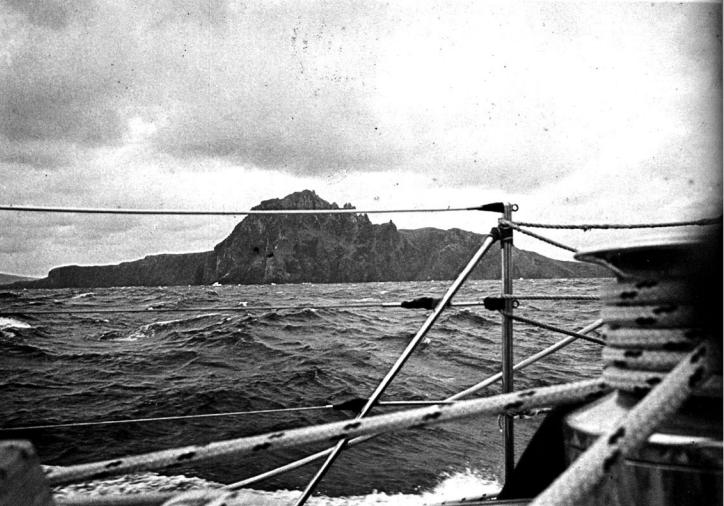
Cape Horn: The most exciting moment of my life
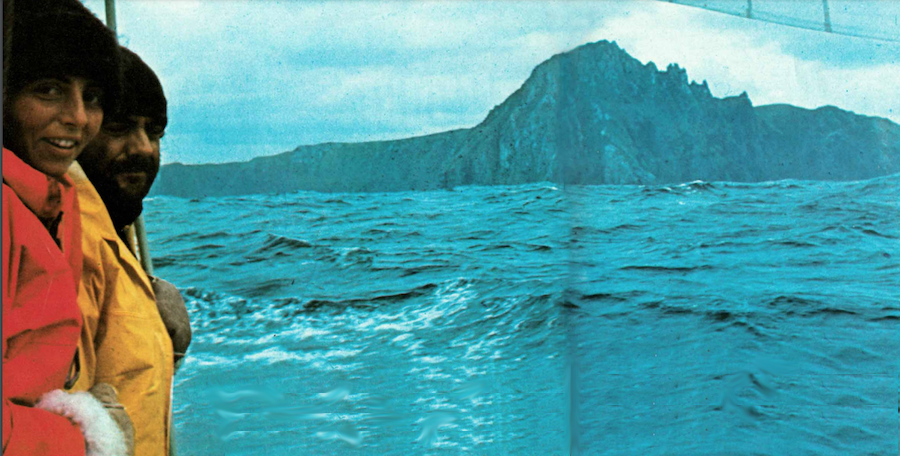
I’m off shift on the 19th, but I can’t get to sleep. I get on deck, take the helm at 3, 35-40 knots from SW, genoa 3 tangoned, two hands of reefing to mainsail. I spot the islands of Tierra del Fuego. We land on Cape Carfort, dark green sea, high, violent. Dante’s land that smokes clouds. You catch a glimpse of grass, rock, snow after 26 days at sea. It is the most exciting moment of my life. Vittorio fails to intimidate us with his terrifying tales of the ghosts of the Horn. We coast, crosswind; Cabo Catedral de York stands imposing. We leave Les Islas Ildefonso to starboard, Falso Cabo de Hornos, lIsla Hermite and the Horn. We are terribly excited. The sea, only rough, allows us to pass within half a mile, at the edge of the foam-white shoal on which the waves break. It is the one of photographs, of stories. Even more beautiful than the one dreamed of and desired. Now it appears milder to us. Gray and white, craggy. I live the mad dream of climbing it, riding the monster. Two routes, the south, more beautiful, the jagged SE ridge. Behind it an English-style meadow, sprawling and immense, bewildering in sweetness. This is the other face of the Cape. We laugh excitedly, perhaps to release some of the tensions of this incredible day. The big Horn is soon small aft, and disappears recoiling in a clump of sleet, as if to punctuate its invulnerability. We pass the spires of the Deceit Islas, the Strait of Lemaire, covering 28 miles in two hours, with 6.2 knots of current in our favor. A red dot comes toward us. It is theEndurance, a British Navy oceanographic ship tasked with marking the Horn’s passages. It is good to see that it is here especially for us. She circles around us a bit, films, they all wave and salute us at attention with the lowering of the flag!!! We look good, it seems, under starcut, Yankee, one hand.
The surprises are not over
However, the Atlantic holds some surprises for us. A violent depression, with the always stupendous stern swell, breakers on deck and glides. On 33 Export we come close to drama. A big breaker corrals them. Untied, they fly in three. Eric Letrosne (of the Benbow crew), finds himself out of the stanchions, unconscious. A leg twisted to a dragnet holds him on board. They retrieve him and the situation appears very serious. He has a compound fracture of the femur. He cannot even be moved and is injected with morphine in the cockpit. Emergency call on 2182, but the promised offshore tug never leaves: the Brazilians mock them. They then head for Rio Grande do Sul, 600 miles away, putting on the stern when the boat beats too much upwind. They run out of medicine and decide to meet up with Japy Hermes, who practically crosses their course. Sea conditions do not allow the boats to stay on board and water and medicine are thrown overboard. Japy’s doctor swims up to 33 Export with whom he will continue to Rio Grande where Eric and two other crew members in poor condition are happily treated. At 800 miles from Rio we begin to windward in fresh NNE winds. The water is very warm, the sun scorching, the flying fish herald the trade winds. We fish a nice dorado. Square edges with very low real runs, 100-120 miles daily. It beats hard in the short sea. The sails are now frayed and burst with disastrous speed. Three spi, five jibs, and the usual mainsail in a few days. The practice is the mainsail ripping entirely when the boat hits the wave. All that remains is a shred attached to the sheet, and the sail flapping free in the wind. We realize the mistake we made in not having procured a game of new sails in New Zealand. A sail sewn to normal standards cannot possibly hold up for an entire round trip.
Cape Horn: Warm reception and ninth place ranking
Infections, furunculosis on arms and legs are reported on many boats. Avitaminosis, wetness, viruses on board? Opinions are still divided. At dawn on the 3rd we spot the familiar silhouette of Corcovado. We cut the line at 4 local time, after losing several hours, in the coastal bonanzas. Below the Pan de Açucar, at the Iate Club, we are greeted by friends and capirinhe in the tropical euphoria of Carnival. Gauloises is first, Flyer second, Traité de Rome third. King’s Legend, in seventh place, gambled on the final result, while Flyer has now put a serious mortgage on victory. Pen Duick, third place, was disqualified because she did not have a valid tonnage certificate for 1977. The ORC refused to renew it because of the uranium keel, which Tabarly, embittered, has now decided to change. It still remains difficult to define a winning boat for the next round. The super light ones, 33 Export and Gauloises, can win
a leg but sooner or later they split(Gauloises even twisted the mast under the compression of the spinnaker), and are not likely to be able to win outright. The big ones, at the 70-foot limit, cannot pay for their ratings. The best remain the medium-large boats, such as Flyer, or the very fast Admirals Cupper, as the excellent Traité de Rome regatta can demonstrate. Our ninth place ranking is partly justified by numerous hours lost due to too many defaillances of our sails, and about 20 days upwind, a gait that is not very favorable to us.
Pierre Sicuori
Check out the latest issue

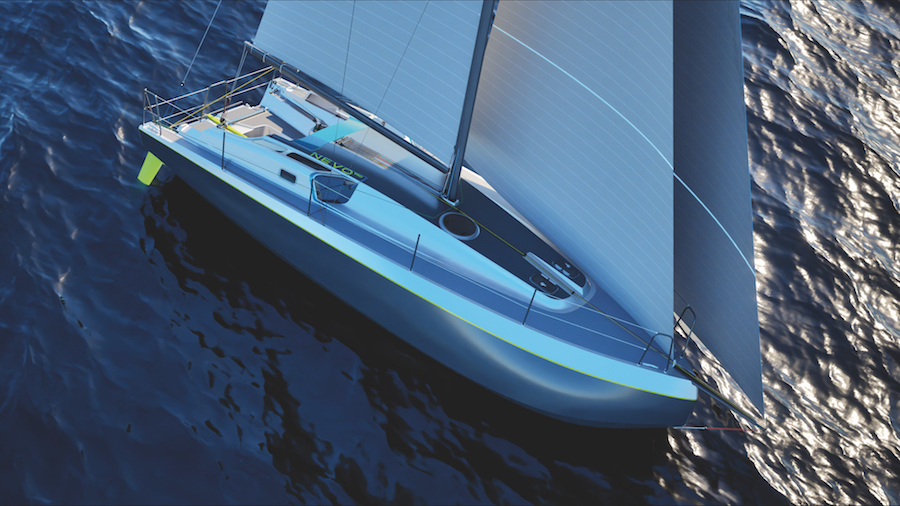
Michele Molino, nautical engineer with the sea in his vein
On the occasion of the 50th anniversary of the Journal of Sailing, the great excellences of the sailing world tell their stories and reveal their projects. In this column, discover all the companies and people who have made important contributions
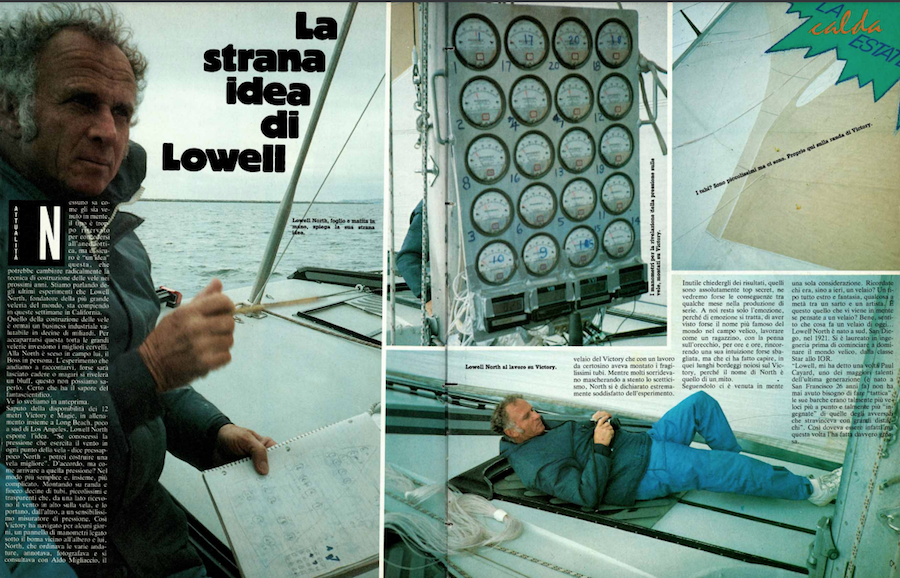
1985. The sails of the future are being born. The GdV is in, with Lowell North
Welcome to the special section “GdV 5th Years.” We are introducing you, day by day, An article from the archives of the Journal of Sailing, starting in 1975. A word of advice, get in the habit of starting your day
Marinedi, the integrated hospitality system
On the occasion of the 50th anniversary of the Journal of Sailing, the great excellences of the sailing world tell their stories and reveal their projects. In this column, discover all the companies and people who have made important contributions
Naval revolution goes through Judel/Vrolijk study
On the occasion of the 50th anniversary of the Journal of Sailing, the great excellences of the sailing world tell their stories and reveal their projects. In this column, discover all the companies and people who have made important contributions

