
Welcome to the special section “GdV 5th Years.” We are introducing you, day by day, An article from the archives of the Journal of Sailing, starting in 1975. A word of advice, get in the habit of starting your day with the most exciting sailing stories-it will be like being on a boat even if you are ashore.
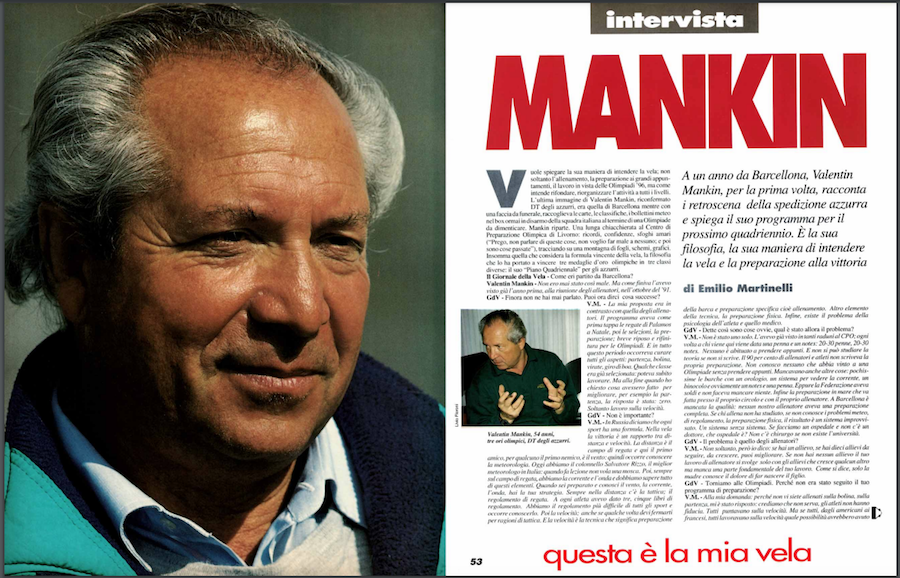
Mankin: this is my sail
Taken from the 1993 Journal of Sailing, Year 19, No. 05, June, pp. 52-54.
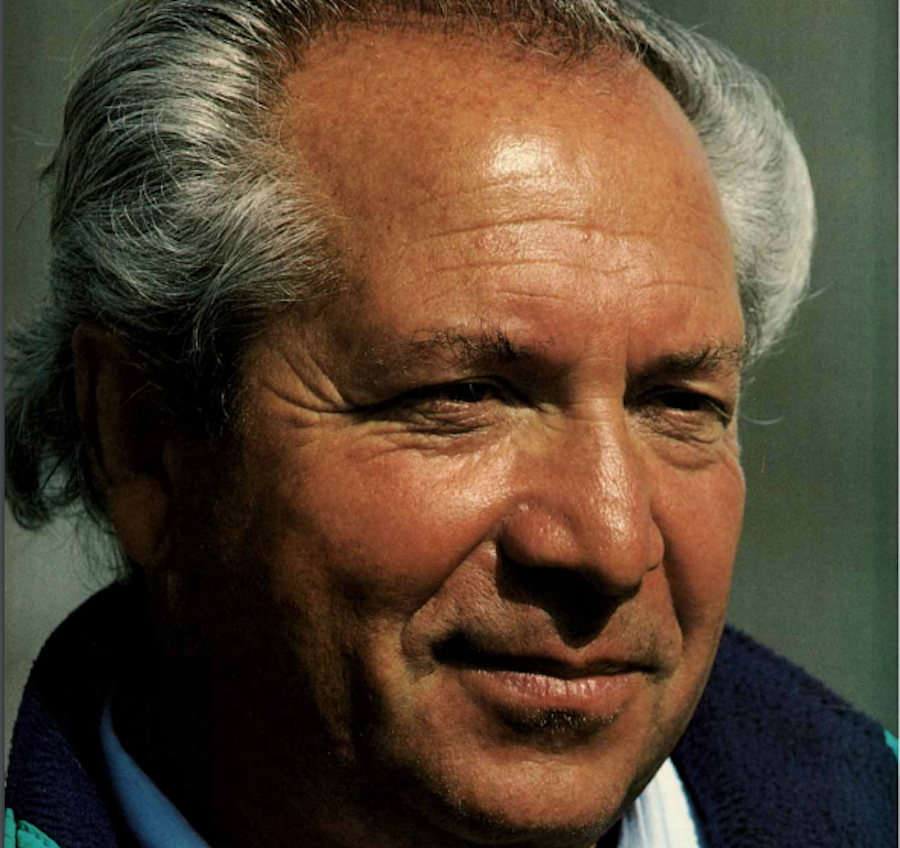
This is how one prepares to win the Olympics according to Valentin Mankin, one of the greatest sailors in history, then technical commissioner of the Italian national team. A masterful lesson, a philosophy of life, a preparation for victory. Unabashed.

One year after Barcelona, Valentin Mankin, for the first time, tells the background of the Italian expedition and explains his program for the next four years. It is his philosophy, his way of understanding sailing and preparing for victory.
He wants to explain his way of understanding sailing: not only training, preparing for the big events, working towards the ’96 Olympics, but how he intends to refound reorganize the activity at all levels . The last image of Valentin Mankin, reconfirmed DT of the Azzurri, was that of Barcelona as, with a face like a funeral, he was collecting the papers, the rankings, the weather reports in the now-disarrayed box of the Italian team at the end of an Olympics to forget. Mankin restarts. A long talk at the Olympic Preparation Center in Livorno: memories, confidences, bitter outbursts (“Please, don’t talk about these things, I don’t want to hurt anyone; besides, they are things past”), tracing on a mountain of papers, diagrams, charts. In short, what he considers the winning formula of sailing, the philosophy that led him to win three Olympic gold medals in three different classes: his“Four-Year Plan” for the Azzurri.
The Sailing Newspaper – How had you departed from Barcelona?
Valentin Mankin – I had never been so bad. But how it ended I had already seen it the year before, at the coaches’ meeting in October ’91.
GdV – So far you haven’t talked about it. Can you now tell us what happened?
V.M. – My proposal was contrary to that of the coaches. The program had as its first stage the Palamos regattas at Christmas, then selections, preparation; short rest and finishing for the Olympics. And throughout this period all aspects had to be taken care of: starting, upwind, tacking, gybing. A few classes were already selected: they could work right away. But in the end when I asked what they had done to improve. for example the start, the answer was: zero. Only work on speed.
GdV – Isn’t it important?
V.M. – In Russia we say that every sport has a formula. In sailing, victory is a relationship between distance and speed. The distance is the race course and here the first friend, for someone the first enemy is the wind: so you need to know meteorology. Today we have Colonel Salvatore Rizzo, the best meteorologist in Italy: when he lectures, not a fly flies. Then, always on the race course we have the current and the wave and we have to know all of these elements. When you are prepared and know the wind, the current, the wave, you have your strategy. Always in the distance there is the tactics: the regatta rules. I had given each athlete three, five rule books. We have the most difficult rulebook of all sports and you have to know it. Then speed; although sometimes you have to stop for tactical reasons. And speed is technique which means boat preparation and specific preparation i.e. training. Another element of technique, physical preparation. Finally, there is the problem of the psychology of the athlete and the medical problem.
GdV – Put like that they are obvious things, so what was the problem?
V.M. – It was not just one. I had already seen it in so many gatherings at the CPO; every time those who come here are given a pen and a notepad: 20-30 pens, 20-30 notepads. No one is used to taking notes. And you can’t study theory if you don’t write it down. Ninety percent of coaches and athletes did not write down their preparation. I don’t know anyone who won at an Olympics without taking notes. Other things were also missing: very few boats had a watch, a system to see the current, binoculars, and of course a notepad and pen. Yet the Federation had money and did not lack anything. Finally, preparation at sea, which has to be done at one’s own club and with one’s own coach. In Barcelona there was a lack of quality: none of our coaches had complete preparation. If those who coach have not studied, if they do not know about weather, regulation, physical preparation, the result is an improvised system. A system without a system. If we make a hospital and there is no doctor, what hospital is it? There is no surgeon if there is no university.
GdV – Is the problem one of coaches?
V.M. – Not only, however I say, if you have one pupil, if you have ten pupils to follow, to grow, you can improve. If you don’t have any pupils your job as a coach is only with the pupils someone else raises but a fundamental part of your job is missing. As they say, only the mother knows the pain of giving birth to the child.
GdV – Back to the Olympics. Why had your preparation program not been followed?
V.M. – To my question: why didn’t you train on the upwind, on the start, I was answered: we think it’s not needed, the athletes don’t have confidence. Everyone was focusing on speed. But if everyone, from the Americans to the French, everyone was working on speed what chance would the Italians have to be faster overall? By what magic? From the very beginning of my activity, when I was 15 years old, I did not put speed first. At the first international regattas I said to myself, “How can I be faster than the Americans who have industry and research behind them? OK Valentin, speed is the second thing!” To be fast, without needing money, the only way I had was to make the best turns in the world, the best gybes, to understand the wind better. All the things that don’t cost money. All very simple things. In the boat you have three opponents: the wind, the wave, the current. Try to wrestle with these opponents-you can confront them on your own. Then there are the other competitors, and each time it is a different story. And that’s the fantasy. But if you are prepared, if you are calm, there is no effort in writing this story. At my first Olympics, at the first trial, I look at the starting line and see that fifty meters from the buoy there is room: everyone is afraid. I relaxed, a leg massage and zac, left tack start, first. If you’ve done it 1,000 times it’s no big deal. The good places on the race course are always crowded; only if you do something better can you get out of the group, only if you know where to go do you run away. Nobody gives you anything. You don’t improvise in the boat. Barcelona was the result of improvisation. So many bad starts and PMS.
GdV – Now you start over, with what power?
V.M. – That of a DT. Especially if I lose I can analyze why, I can try to understand where I went wrong, I can correct; before with class coaches if you lost the reasons were a hundred. I didn’t know what was done, what were the causes.
GdV- How is the staff structured?
V.M. – Our base is the personal coaches, the circle coaches. And the CPO must be the university for coaches, the home of research and the Olympic team. No more venue for youth gatherings that last three days and cost a lot of money. For the youth we reserve the summer months when the team is not there, the schools are closed and the children can stay not three days but two weeks. But the base remains the club coaches, the ones who grow the athletes. We provide them with the program and the specialists. But let’s come to the staff. From the Moro experience, which is an example for all of us, comes Andrea Madaffari, athletic trainer: in him I see the first coach. The issue of physical preparation is fundamental. I have never seen a country with so many good athletic trainers and such physically weak athletes. Being strong means not being afraid of the wind. Last year in the morning gymnastics I was alone like a dog. Then there is the problem of boat preparation and John Neri from CPO has hands of gold. For sea training where safety, assistance and many other things are needed there is Marco Mercuriali and Manfredo Audizio. To these four people we have to add a psychologist and a doctor because we are always working at our best and something can break: I am looking for them.
GdV – How is the staff structured?
V.M. – Our base is the personal coaches, the circle coaches. And the CPO must be the university for coaches, the home of research and the Olympic team. No more venue for youth gatherings that last three days and cost a lot of money. For the youth we reserve the summer months when the team is not there, the schools are closed and the children can stay not three days but two weeks. But the base remains the club coaches, the ones who grow the athletes. We provide them with the program and the specialists. But let’s come to the staff. From the Moro experience, which is an example for all of us, comes Andrea Madaffari, athletic trainer: in him I see the first coach. The issue of physical preparation is fundamental. I have never seen a country with so many good athletic trainers and such physically weak athletes. Being strong means not being afraid of the wind. Last year in the morning gymnastics I was alone as a dog. Then there is the problem of boat preparation and John Neri from CPO has hands of gold. For sea training where safety, assistance and many other things are needed there is Marco Mercuriali and Manfredo Audizio. To these four people we have to add a psychologist and a doctor because we are always working at our best and something can break: I am looking for them.
GdV – A half revolution…
V.M. – No, an open door. The coach has to know all the issues from meteorology to athletic preparation. When I see that in Optimist the coaches are waiting for other coaches to come in and do the athletic preparation I think they are wrong. But more than that: with this system there is no one “in charge.” If a coach takes his students to the highest level he becomes the coach of the class on the Olympic team. He will be the one who goes to the Olympics; we just give support.
GdV – This is the staff. What about the team?
V.M. – We have three groups, the first with the best in Italy by results as CONI wants. These are the POs, Probable Olympians, those ranked in the top six at world and European championships; the second group Olympic Interest, with all the Italian champions. Finally, the third group, the High-Specialty team, with all those who for whatever reason, an illness, a setback, did not perform but are talented.
GdV – In the number one team, however, there are not all classes…
V.M. – The Finn is missing because Emanuele Vaccari told me he wants to rest and I certainly can’t force him in. It is the same for the Tornado as well. Zuccoli has many commitments, however if he does the results, if he gets into the 20 percent he will have the same support as the others. That goes for everyone.
GdV – How come only now all this news?
V.M. – In ’90 when I arrived, Sergio Gaibisso told me “take over everything” but I wasn’t ready: because of the language, because I didn’t know the mentality. The coaches had been fired, but I didn’t think they quit like that. I didn’t think they didn’t like their job. After three months alone they came back. I started the coaching school right away, but everyone had his own commitment. Who the store, who the sailmaker, who else. I didn’t know what they were doing. I knew they were getting their salaries. We spoke different languages, in every sense of the word. Only now with the president, with Arrigo Marri (president of the Olympic Classes Commission ed.) and Paolo Rosi (National Competitive Activities Commission ed.) can I do my job; that of a technical director, of a soccer coach: there are many roles but the program is unique. But there are so many problems. That of different selections from class to class. Only for the Star is clear and allows for programs. For Europe between February and March we have five national selections between February and March, spending 40 million, and it takes away from preparation. If we don’t start from the Circle, and then from the zone and then, as it were, from Italy, we will never have a national team.
GdV – You say we need to start with Circles, but Circles have less and less money. How is it done?
V.M. – To do the Circle training, to do the small Circle regattas, you don’t need millions. You just need the Circle to want to live. And then if there is to do the zonal regatta the Circle finds the money, even to do the national regatta. The money is there, it is necessary to use it well. What were the results of the Laser world championship, almost 60 million spent on? For nothing!
GdV – Do you have any foreclosures against anyone?
V.M. – I’m not a jerk, everyone is important. And above all, I don’t want to see the Italian flag so low anymore.
GdV – Are you satisfied?
V.M. – I would say yes. I like to work and I like hardships. I’m 54 years old and after almost 30 years as an athlete and coach I thought I would end up as a retiree, being a fisherman. Instead, today I have found a second life. However, sometimes there are problems that I just don’t understand. For example, in October and November when there are no rallies, I go to Antignano to give lectures on regulation: it is important to talk, to pose problems, to keep studying. Well, someone said I don’t have to do that. But how, I’m working for everybody and it’s not okay? Maybe it’s more okay to do nothing and wait for the paycheck? I don’t think so, also because that unearned money is taken away from the activity of younger people.
GdV – It is a challenging program; will you be able to implement it all the way?
V.M. – Yes. The fact that someone like Enrico Chieffi is here proves that, the work that has already begun proves that. But one thing I think is important for his success: now there is no one on a pedestal. Those among the coaches who go up, go up because of the work they do with their students, and there is no one who is just on top. The same for athletes. However, without exchange of information everything becomes difficult; that is why I speak of an open door. If a reader, a coach, an athlete, a fan, anyone wants to ask us a question, pose a problem, write to us, come here to the CPO. We will answer them. Here will be born, already exists, the university of sailing.
GdV – How does Valentin Mankin feel today?
V.M. – Good. We have a lot of work. The colleagues and the guys are loaded: 24 hours is a short time for all we have to do. Besides, I have a great desire to give: it makes me happy.
by Emilio Martinelli
NDR – Valentin Mankin passed away in Viareggio, Italy, on June 1, 2014. His contribution to Italian sailing was instrumental and helped shape one of the best generations of Italian sailors.
Check out the latest issue

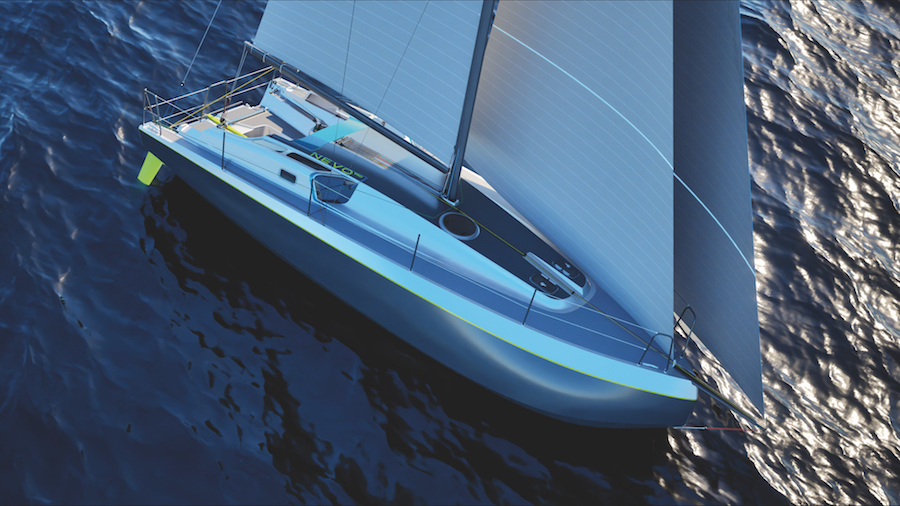
Michele Molino, nautical engineer with the sea in his vein
On the occasion of the 50th anniversary of the Journal of Sailing, the great excellences of the sailing world tell their stories and reveal their projects. In this column, discover all the companies and people who have made important contributions
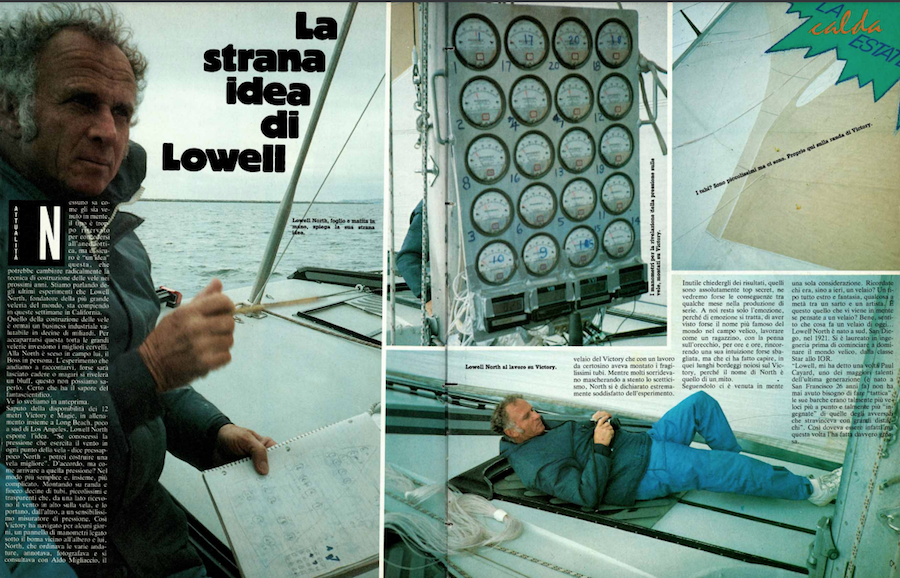
1985. The sails of the future are being born. The GdV is in, with Lowell North
Welcome to the special section “GdV 5th Years.” We are introducing you, day by day, An article from the archives of the Journal of Sailing, starting in 1975. A word of advice, get in the habit of starting your day
Marinedi, the integrated hospitality system
On the occasion of the 50th anniversary of the Journal of Sailing, the great excellences of the sailing world tell their stories and reveal their projects. In this column, discover all the companies and people who have made important contributions
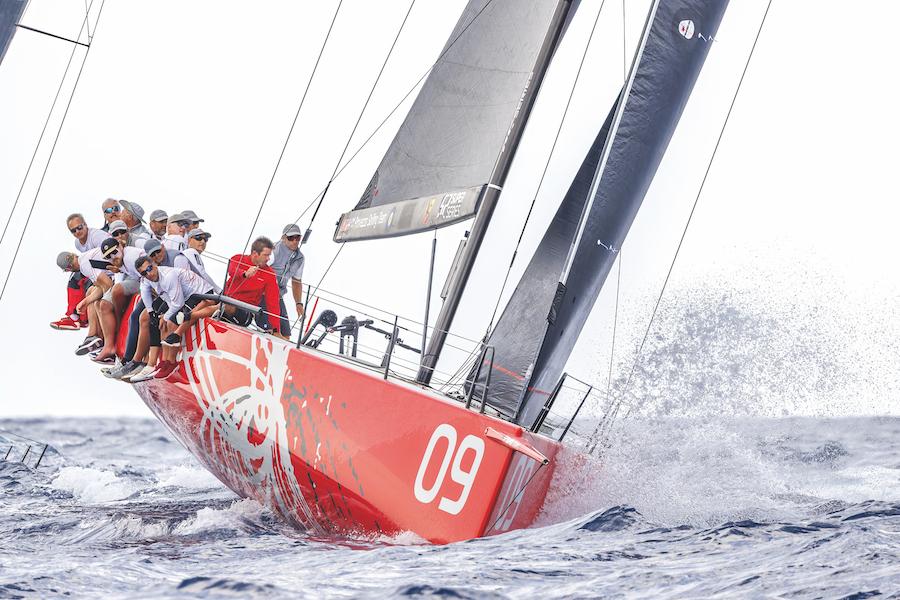
Naval revolution goes through Judel/Vrolijk study
On the occasion of the 50th anniversary of the Journal of Sailing, the great excellences of the sailing world tell their stories and reveal their projects. In this column, discover all the companies and people who have made important contributions

