
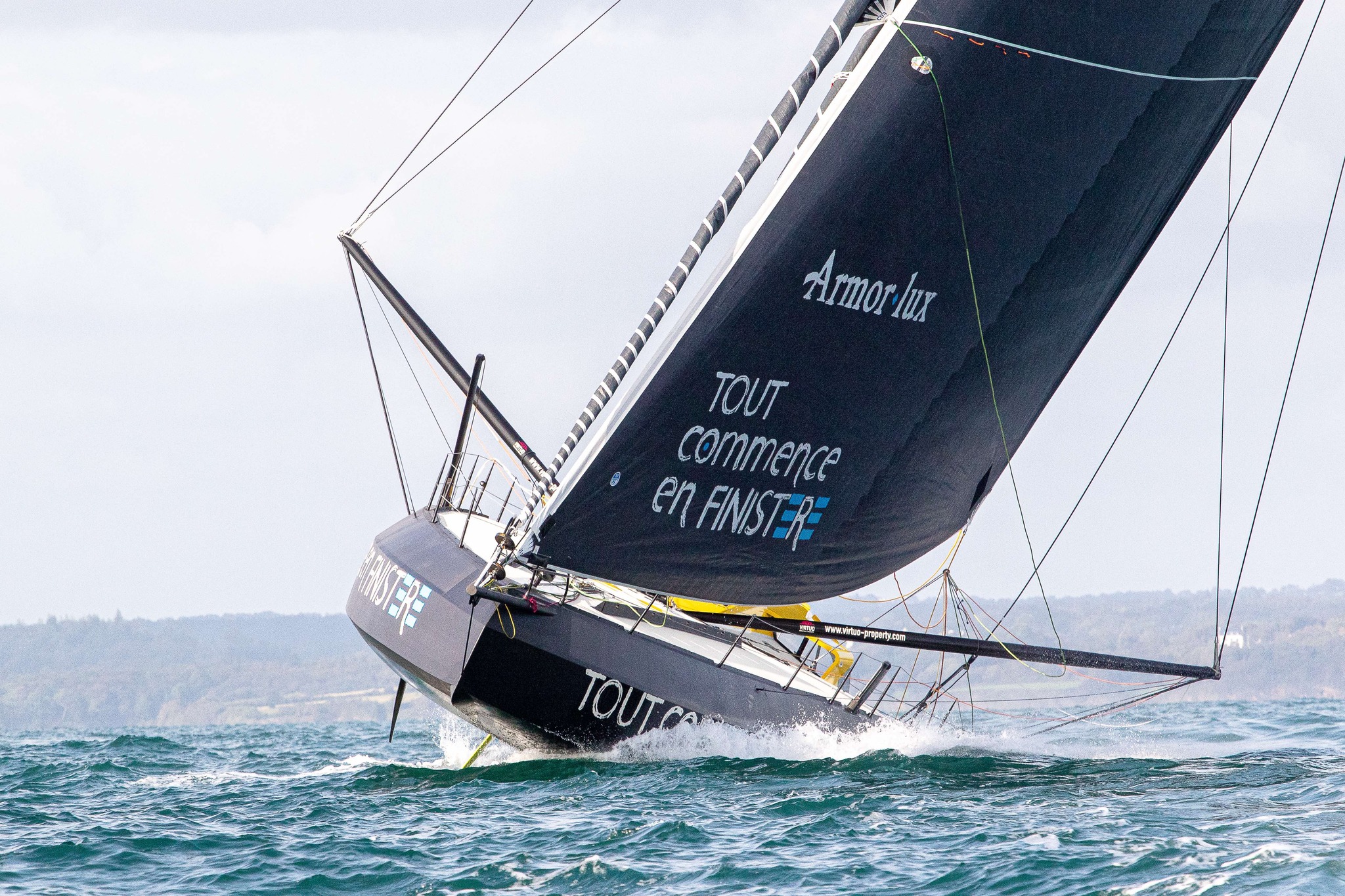
Jean Le Cam has just launched his new IMOCA 60 and, hear hear, it has no foils. The 64-year-old Frenchman, from Finistere, is not just any sailor but one who often and frequently goes against the current. He has five Vendée Globes in his wake and is preparing, as always in his own way, for the sixth. Le Roi, a nickname that comes from his many victories in the Figaro class that helped birth his legend, has never made a secret of his skepticism toward foils applied to Imoca 60s.

With his old dinghy Imoca at the last Vendée Globe he stayed in the foilers’ wake for a long time, finishing in fourth position after also pulling Kevin Escoffier to safety. This gave rise to his belief in another possible path for the new generation of Imoca 60s, a path that does not involve the use of foils.
Jean Le Cam has just launched his new 60, Tout commence en Finistère – Armor-lux, built by Italian Persico Marine, with which he will prepare for his sixth round-the-world race, and as promised the boat has no foils. The design is by David Raison, the genius, engineer and sailor, who introduced scow bows to the World Mini 650 and then transferred them to the Class 40s as well, later influencing a whole generation of designers, who brought the idea, albeit “sweetened,” into the world of cruising boats.
Imoca 60: foil yes or foil no?
Jean Le Cam’s Imoca 60 is the only new generation boat that does not have foils. The statistics at the moment are against Le Cam’s conviction: since the Imocas opened up to the new appendages on the top step of the podiums of the Vendée Globe and other races reserved for the class only foilers have climbed. There is one “however.” There has been no more research and design development work on foil-less boats in recent years, as all sailors and naval architects have turned to foilers. Le Cam has taken up this thread, with the belief that a new Imoca 60, with an updated hull, can play on par with the Imoca foils.

Where does Le Cam’s conviction come from? There are some details that would seem to prove him right. The foils on the Imoca have a range of effectiveness that is not too wide: they perform very well from upwind wide to leeward in winds ranging from 10-12 knots up to about 30-35, in not overly formed wave conditions. In a regatta like the Vendée Globe there can be many phases when the weather is not so favorable to these types of boats.
Upwind with little wind, a full stern, and a very formed wave are not conditions in which foilers can develop their full potential. Especially in winds over 35 knots and very formed waves, foils put monstrous stresses on boats, which is why skippers often retract them to the maximum at these junctures and end up “braking” the boat underinhaling it to avoid structural damage.
To withstand such stresses, Imoca foils have significant structural reinforcements in the lever areas of the appendage, a fact that makes them heavier than a boat with a classic configuration. Le Cam’s idea is precisely to have a more all round craft, capable of being very fast even upwind in the transitional phases with little wind, and able to hold its own without slowing down when in the southern oceans there is strong wind to ride. And then there is also the UFO risk: foils increase the possibility of hitting drifting objects resulting in structural damage.
The secrets of Le Cam’s Imoca 60
The Imoca 60 Tout commence en Finistère – Armor-lux has at least a couple of rather interesting features. The first is in the bow: volumes are at the maximum allowed bylla class, almost a scow, but just below the bow the boat has a kind of “fin.” At least one hypothesis can be made about David Raison’s reasons for this choice: boats that have such powerful bow volumes tend to have a headrest tendency given by the geometries of the hull and bow in particular.
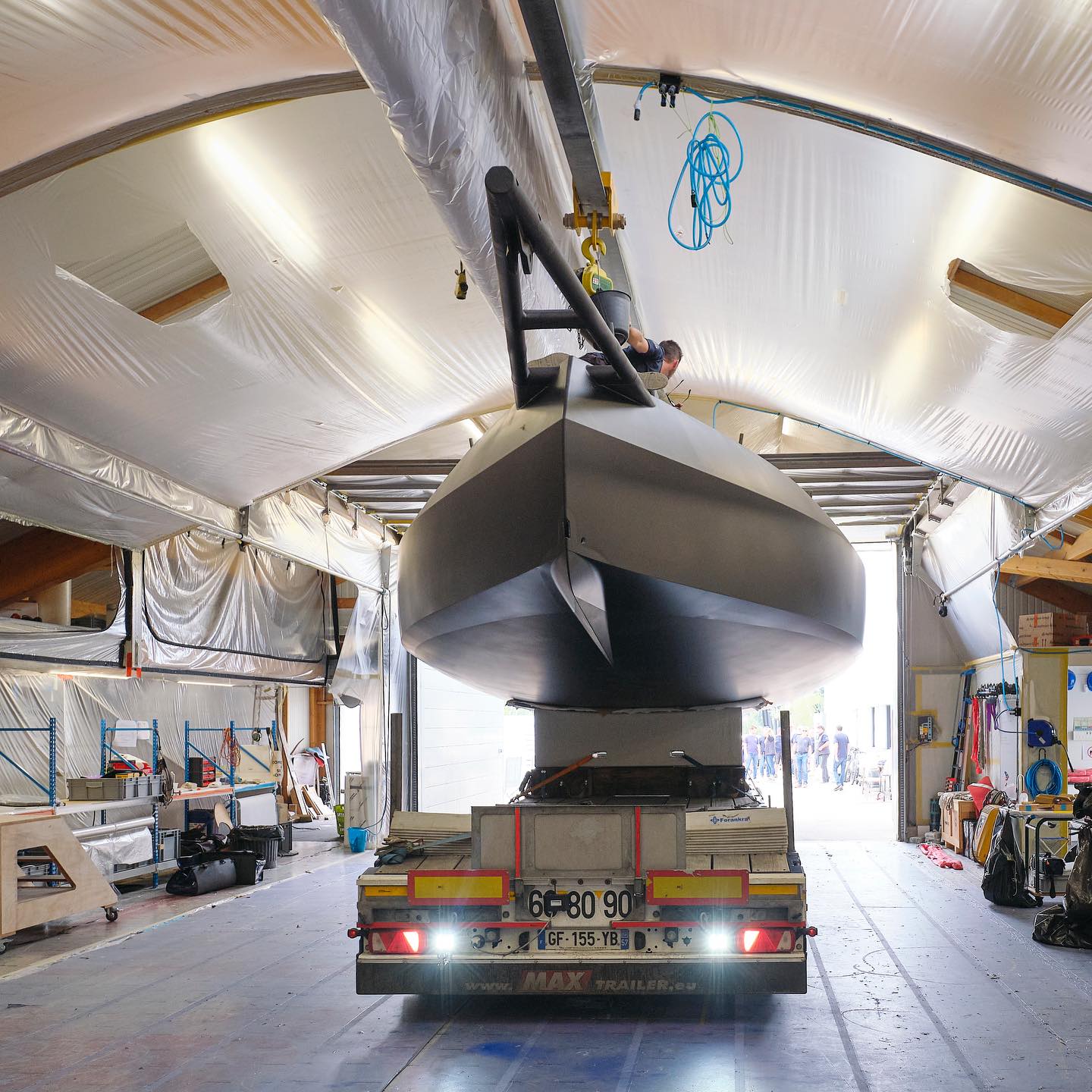
This tendency is usually combated by moving the sail plan and drift blade backward, or by counteracting it with mast rake (the tilt toward the stern). Verisimilarly, Jean Le Cam’s “fin” will help the boat not “throw” the bow to leeward upwind, especially in wind conditions that are not too strong, and it will also help contain the drift.
The other interesting detail is the position of the daggerboards, the drifts that are submerged as soon as the canting keel is no longer in the middle position. Their purpose is to contain angled keel drift, but in the configuration chosen by Le Cam there may be more to it than that. The angle of the two drifts ideally goes to form a V, and these are positioned on the maximum beam of the boat and not in the middle as was the case with the older generation Imoca drifts.
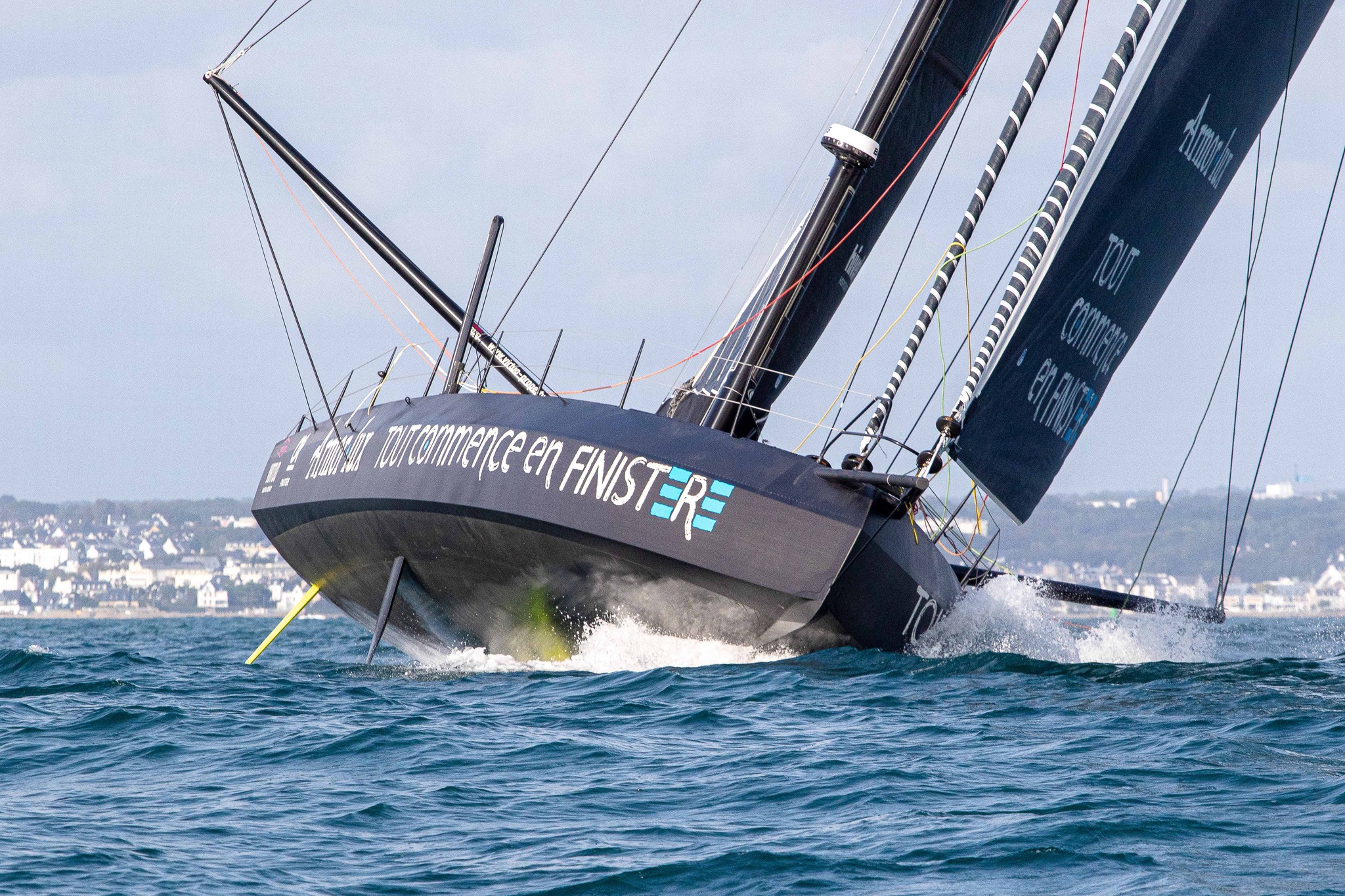
This configuration makes the assumption that David Raison wants to recreate a lift, uplift effect, as well as counteracting drift, to reduce the boat’s wetted surface area. It does not mean to make the boat “fly” as foils do, but to reduce hydrodynamic drag. It is no coincidence that from the very first sail outings Le Cam’s Imoca shows a propensity to sail high on the water, something the older generation Imocas without foils did not do.
This is a big bet, one that goes against the trend and is intended to disprove the statistics that have so far always seen foilers winning since the new appendages were introduced. Le Cam will not be at the start of the Transat Jacques Vabre, so the confrontation will be postponed until 2024, pending the Vendée Globe.
Mauro Giuffrè
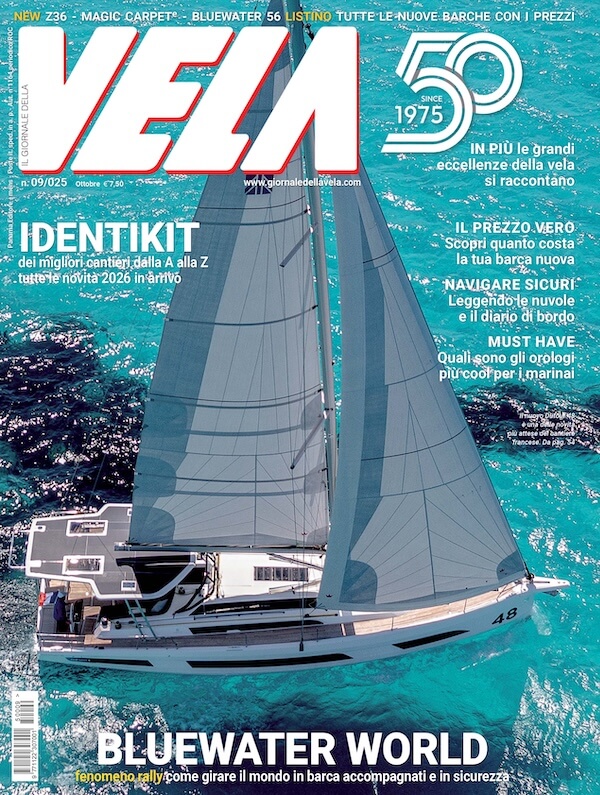
Check out the latest issue

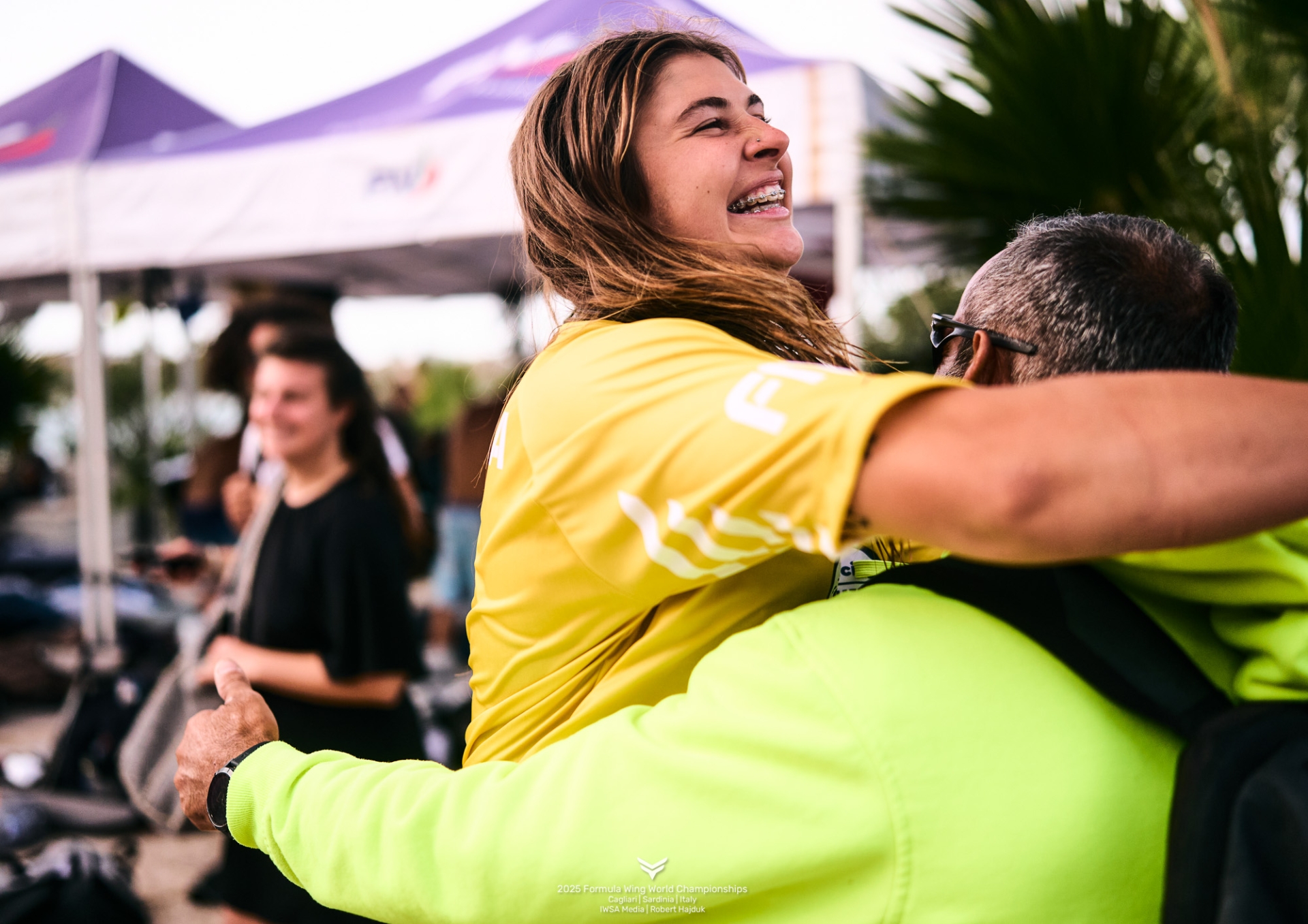
Winning a world championship in your own land is a crazy thrill. Right Magdalena?
Winning a sailing rainbow title is a huge satisfaction. Winning it in one’s own land is even more so. Maddalena Spanu, born in 2006, from Cagliari (but living in Oristano), is the first women’s Formula Wing world champion in history.
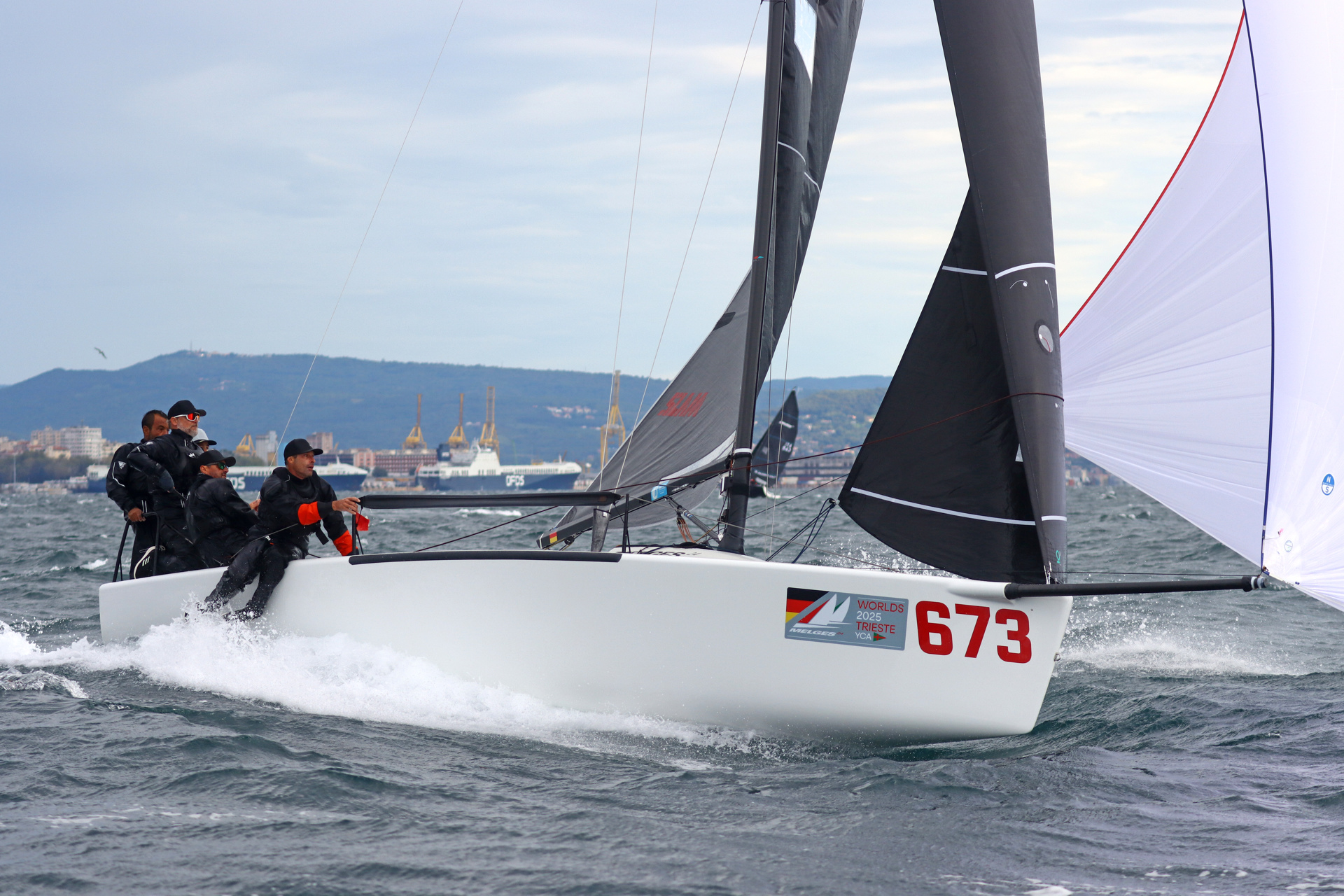
Monotype gathering more than 70 boats at the Worlds after 30 years
Can you find the perfect, and long-lived, racing boat in just 7.32 meters in length? You sure can, especially if the boat in question is called a Melges 24, and proving it, yet another confirmation, was the class World Championship
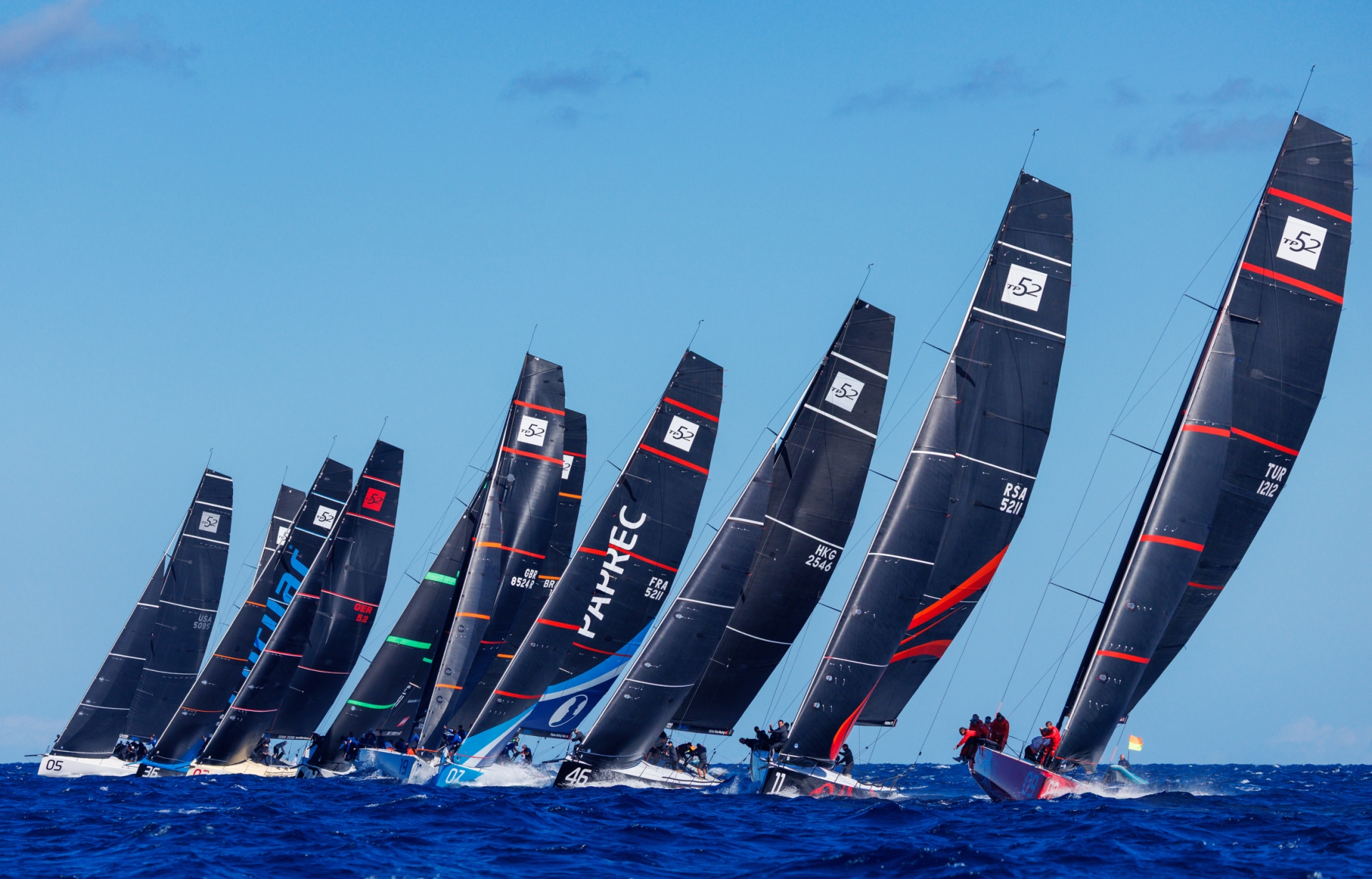
The 2025 52 Super Series season comes to a close: here’s how it went in Porto Cervo
The 52 Super Series-Porto Cervo-Range Rover Sailing Week, which was held Sept. 22-27 in Porto Cervo, in the waters in front of the Yacht Club Costa Smeralda and which closed the club’s 2025 sports season, has come to an end.
Les Voiles de St. Tropez 2025: vintage boats, maxi yachts and modern hulls for an exceptional edition
From September 27 to October 5, 2025, the Gulf of St. Tropez will welcome more than 240 yachts, including 70 units over 20 meters. Between traditional, modern and maxis, this 27th edition of Les Voiles de Saint-Tropez promises to be

